2009 Suzuki SX4: What's It Like to Live With?
Read the latest updates in our long-term road test of the 2009 Suzuki SX4 Crossover as our editors live with this car for a year.
What do you want to know about?
- Introduction
- I Like It
- Track Tested
- Range
- Seatbelt/Airbag Warning
- Wounded
- The "Hidden" Navigator
- Doesn't Really Live Up to the Hatchback Promise
- Airbag Warning Light Resolved
- Good Transmission. Good Shifter.
- Not bad at all
- Technical Bang for the Buck
- What is "Satisfacti" by the "Rolling St"?
- Touch Point...or is that Ouch Point?!
- Suzy Does San Diego
- Looks Better Than a Fit or Versa
- Booming Sales Create Problems
- 5K Milestone Achieved, $1.45 After Party
- Front Seat Comfort
- Laziness Results in 256-Mile Tank
- AWD For Rainy Conditions?
- Crash Test Videos
- AUX is a Dealer Accessory
- Discreet Navigation
- Elementary Aqua
- Man, That's a Big Door Ding
- The Airbag Warning Light is Back
- Easy to Check the Oil
- Doin' Chores
- Nice
- Airbag Light Service, Chapter 2
- The Range Readout
- A Fold Flop Fest
- Falling Out of Like
- Meet Its More Athletic Brother
- 2 Ways the Garmin Nuvi Is Better Than iDrive
- Falling Into Like
- These Gauges Drive Me Up the Wall
- Pleasures and Perils of a Tall Seating Position
- Handling Is Far Better Than Average
- Airbag Light STILL Broken
- Cargo Net
- Fat A-pillars
- Fiat Comes to America
- L.A. Drivers Hate It
- Jam It
- Ain't No Driver Seat High Enough
- Airbag Warning Light Saga Continues
- Easy To Be With
- Cockeyed Wheel
- OK A/C
- Built-In Removable Navi is a Great Idea
- They Made It Better Than Before
- What It Can Do With 873 HP And, Uh, a Few Choice Mods
- My Wish List
- Some Unexpected Features Here...and Not
- Navigation Leaves Me at Arm's Length
- Small Tank, Cautious Gauge
- Practicality Minus the Entertainment
- Shop Truck?
- Gaps Are All I See
- Back Seat Passengers
- How Low Can You Go?
- Owner's Club Meeting at Suzuki HQ
- Bovine Engine Note
- Suspension Walkaround
- Mp3 Capabilities
- Airbag Warning Light Resolved, Again
- Dashboard Controls I Can Live With
- Steering by Robocop
- Oregon Road Trip, Part 1
- Oregon Road Trip, Part 2
- Oregon Road Trip, Part 3
- Oregon Road Trip, Part 4
- Checking Oil, Praising Headlights
- Good Steering Wheel in $18K Car
- Such a Little Nav
- Turn Up Your Volume
- Mirror, Mirror
- Comfort Optional
- Getting Looks
- Options
- I Can't See the Buttons
- I Can See for Miles and Miles
- Road Trip Test
- Keeping it Simple
- Living Dead Pedal
- I Don't Fit in the SX4
- Stacking It Up
- Delicate Cargo
- Haulin'
- Fix It or Live With It?
- Small, Square Rear Cupholder
- How Did This Happen?
- 20,000 Miles and Change
- DIY Oil Change Video
- Brake Warning Light Mystery Solved
- Parting Shots
- Wrap-Up
Introduction
Check out the page for the 2009 Suzuki SX4 on Wikipedia. Go ahead, we'll still be here when you get back. See that, near the bottom? The most addictive thing in the world isn't sold by the gram or meant to fuel the desire for scrap copper; instead it's lying at the bottom of many Wikipedia pages and it says, "See Also." Clicking this link starts you down a labyrinthine path with no end, only more doors. Yet at the bottom of the page devoted to the Suzuki SX4 crossover, there is only one item listed: the AMC Eagle.
Today, the car-based crossover utility vehicle is meant to be the best of both worlds, with the cabin space, ground clearance and sure-footedness of an SUV, plus the maneuverability and refinement of a car. In reality, however, the crossover tends to combine the size and sure-footedness of a station wagon with the driving goodness of a minivan. It's not necessarily a good thing.
The 1980-'87 AMC Eagle was little more than a stretched Gremlin hatchback on four-wheel-drive stilts. Yet it combined two disparate personalities — rugged childlike playfulness and staunch paternal responsibility — in a way that few thought possible in 1980. And for all the Eagle's lowly heritage, it has set a lasting standard for utility and a friendly, innovative spirit that has eluded most of the compact crossovers on the market today.
Precisely that same combination of utility and spirit lives in Suzuki's all-wheel-drive SX4 crossover. With sheet metal designed in Italy and codeveloped as the Fiat Sedici, the 2009 Suzuki SX4 crossover AWD with the Technology package is the least expensive vehicle available with a navigation system as standard equipment. It's also the first Suzuki to appear in Inside Line's fleet of long-term test vehicles.
What We Bought
The 2009 Suzuki SX4 is not new. In fact, we published our first review of it back in December 2006. We praised it for its good looks, spacious cargo room and the lowest cost of entry for an all-wheel-drive vehicle. For the 2009 SX4, Suzuki hasn't messed with the 2.0-liter engine, which still produces 143 horsepower at 5,800 rpm and 136 pound-feet of torque at 3,500 rpm. Nor has it done much to improve the crossover's EPA fuel economy of 21 mpg city and 28 mpg highway.
It did go ahead and add another of its "cheapest car that..." titles. Now the 2009 Suzuki SX4 is the first vehicle available with an MSRP below $16,000 that offers a fully integrated navigation system. Of course, this title applies to the entry-level SX4 crossover, a front-wheel-drive version with a manual transmission. This all-wheel-drive model with a four-speed automatic transmission has been equipped with the Touring package, floor mats and a rear skid plate, so the bottom line comes to $18,179. Mind you, this is for a vehicle with a three-mode all-wheel-drive system, steering-wheel-mounted audio controls, cruise control, keyless entry, power windows and door locks, four-wheel disc brakes, and a navigation system with a 4.3-inch display screen that features MSN's Real Time Direct included for one year.
So you're saying to yourself, "A GPS navigation system with only a 4.3-inch screen?" This size sounds awfully familiar, you're thinking. Well, you are correct. Instead of wasting time and money on its own proprietary system, Suzuki did what we've been imploring other carmakers to do for years and simply went to Garmin, leader in all things to do with handheld personal navigation devices. The result is a Garmin PND in its own dash-mounted cubby that features voice prompts and MP3 playback, plus it's fully portable. Going somewhere you've never been before? Let Suzuki lead you there and then pull out the Garmin to have a pocket-size travel buddy that knows everything. Parking in a rough area? Take the Garmin out and leave the empty dash pocket, telling would-be thieves, "Look, I've got nothing!"
Speaking of having nothing, nobody's going to strip your SX4 of its cloth seats, urethane shift knob, day-and-night rearview mirror with manual control, or black-plastic interior door handles. These are just a few of the areas in which the 2009 Suzuki SX4 cuts costs in order to achieve its elite status in the function-per-dollar sweepstakes.
Why We Bought It
When we first learned a new Suzuki was on the way to our long-term garage, the cheers went up. Those so inclined prepared helmets and riding leathers, anticipating the first ride of the new SV, Gixxer, or 'Busa. Clearly we'd forgotten that while Suzuki might be bringing us motorcycle technology, it would not be packaged in a motorcycle.
In fact, this SX4 in Vapor Blue Metallic is a reminder that Suzuki has finally left behind such odd choices as the X-90 and the funky rebadged Daewoos and gotten in touch with the same Suzuki spirit that brought us the Samurai, the Sidekick and the Impulse. It's become a more grown-up car company, and as a measure of this, Suzuki has partnered with Fiat in the development of the SX4 (Suzuki has always been very successful in the Italian market, anyway). Italdesign has styled the exterior to help the SX4 crossover inspire some lust among car shoppers, but Suzuki has also provided its seven-year/100,000-mile fully transferable warranty so everyone will know this car is as sensible as you expect a Suzuki to be.
The 2009 Suzuki SX4 might not speed down PCH with the authority of the B-king, but Suzuki is clearly (finally?) putting as much effort into its cars as it does into its bikes.
As Tough as Wisconsin
We knew a guy who had an AMC Eagle. Or more specific, he had three of them. One was for driving, one was what is known colloquially as a "woods beater" and the third was a donor car for spare parts.
Suzuki doesn't want spare SX4s to be lying around to furnish body parts, but it does hope for the kind of loyalty that those made-in-Wisconsin (the place where four-wheel drive was invented) Eagles attracted. Suzuki hopes that the SX4 will not only go to the grocery store for you but also be a part of your adventure. Suzuki wants to be a lifestyle, not just a cheap car.
Well, for the next 12 months and 20,000 miles it's going to be a part of life at Inside Line. Will we think Eagle at the end of this, or will memories of Geo and Daewoo still prevail? Stay tuned.
Current Odometer: 2,109
Best Fuel Economy: 23.2 mpg
Worst Fuel Economy: 20.4 mpg
Average Fuel Economy (over the life of the vehicle): 22 mpg
The manufacturer provided Edmunds this vehicle for the purposes of evaluation.

About two years ago I wrote a full test of the Suzuki SX4 and thought it was charming.
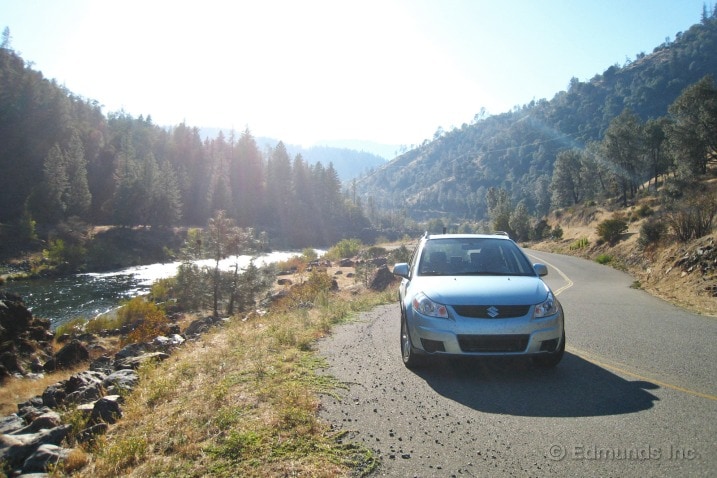
Well, it hasn't changed much for 2009. It could still use more power for its weight. Merging onto the freeway is less than spectacular. But once it gets going, it's fine. It's more than adequate for skipping around town running errands. And with the rear seats folded, you get 54 cubic feet of cargo space.
I think it's cute as hell, especially in Vapor Blue Metallic.

(Photo by Kurt Niebuhr)
Acceleration
0-30: 4.1
0-45: 7.1
0-60: 11.7
0-60 (with 1 foot of rollout like on a dragstrip): 11.4
0-75: 17.5
1/4 mile (ET / MPH): 18.3 @ 76.3
Comments: Yikes it's been quite a while since I've driven something this slow. It didn't matter what I did (esp on/off, brake torque or not) it produced 12-sec 0-60 times. Gear spacing seems quite wide for such a torque challenged vehicle.
Braking
60-0: 125 feet
30-0: 30 feet
Comments: Noticeable dive and ABS action, but good fade resistance.
Skid Pad
.78g
Comments: Steering feels a little "springy", but offers some road feel as well. Understeers on the limit even in "Auto AWD" mode. Some marginal ability to rotate/steer with throttle.
Slalom
62.3 mph
Comments: Pretty lenient / sophisticated ESP system when on. Subtle and early corrections. Shutting it off, the rear will step-out considerably left in FWD, switching to Auto AWD settled it down a bit, but then you really need to know how to throttle while sliding. The mere fact that this is possible is pretty remarkable and says something about its tuning.
Tires: Bridgestone Turanza EL400 205/60R16 91H
Weight: 2,982
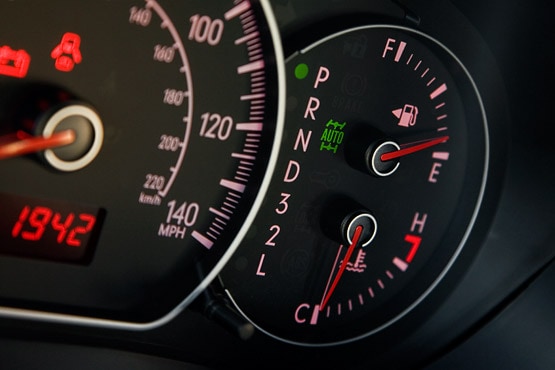
This is going to be an issue. I just know it.
Our little Suzuki SX4 has a little fuel tank; I believe it's just under 12 gallons. Combine that with (relatively) dismal fuel economy and you get a sane, usable range of around 200 miles. If your last name is Jacquot, you might see 280 miles before having to fill up. But I doubt anyone will get 300 miles on a tank with this car.
What's the big deal with that? Well, this idea of 'pain at the pump' comes from always finding yourself at the gas station, constantly having to fill up your car. It's a psychological thing more than anything else, but when you buy a cute, little four cylinder car you might have it in your head that you won't be filling it up all the time. With the Suzuki, you'd be wrong.
For the record, I was the one who recorded our best fuel economy for this car at 23.2 mpg. That was in 2WD, with 80 percent open highway driving. Maybe there's a Z06 endurance tank option we missed?

I noticed this weekend that our long-term SX4's airbag/seatbelt warning light came on and stayed on. At first I thought it was sensing my heavier-than-necessary laptop bag, so pushed the bag to the floor. But nope, the light still glared at me from the instrument panel, all red and warn-y. That's when I realized that there's a separate warning light at the top of the center stack for the passenger airbag warning light. The one pictured (just above the odometer) is the more general "something's up with the airbags and/or seatbelts" light. We'll get it checked out and report back on what was causing it. Stay tuned.

Our SX4 suffered some damage in traffic recently when it was the victim of a love tap to the bumper. That's right — we were rear-ended. The impact was pretty minor and no one was injured, but since the at-fault driver was behind the wheel of a Chevy Express, our little SX4 did not escape unscathed. We're waiting to hear from the claims adjuster, and hope to have the car in the body shop by early next week.

I had our 2009 Suzuki SX4 this weekend and although I have plenty to complain about — its 13-gallon tank that could only seem to swallow 8 gallons at a time and burn through that quickly, for one — I soon forgot all that when I remembered it had a Garmin navigation system. Yes, I completely forgot about the easy-to-work Garmin nav sitting in the jack-in-the-box compartment located on the dash over the radio controls.

I don't have a fancy iPhone but still am able to look up Google Maps on my phone. So as I was sitting in the car waiting for my stupid phone to load the directions, my friend who was sitting across from me was terribly bored and decided to explore the car's dash.
I was just about to throw my phone out the window when said friend tapped the not-so-hidden compartment door and it sprung open to reveal the Garmin, rising from the dash like [insert favorite Indiana Jones treasure here]. ::cue heavenly choir:: Before, we had mistakenly dismissed that compartment as merely an oddly placed cubby.

With huge graphics and clear instructions, we were soon on our way. Speed limit and projected time of arrival are clearly displayed as well. But my favorite part has to be the ability to change the navigator's accent — American (Jack or Jill), British (Daniel or Emily) or Australian (Karen or Lee). Right now the Garmin is Lee. Very hot.

I headed to the laundromat with our long-term 2009 Suzuki SX4 last night. Unlike our 2009 Honda Fit, it's not as practical for hauling stuff as its hatchback shape would lead you to believe. The reason? Its rear seats don't fold anywhere close to flat.
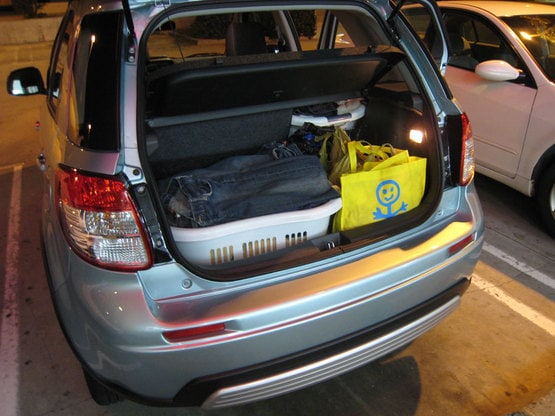
So I ended up leaving the "60" side of the backseat in place in order to brace the laundry basket and keep it from sliding around. As you can see, only one standard-size basket fits in the cargo area — exactly what I'd expect from a car built on subcompact, B-segment platform architecture.
If I really needed to haul stuff in the SX4, though, I'd be unbolting the rear seats. It's nice to get all-wheel-drive in a low-cost car, I suppose, but for the $18K it costs to buy one like our long-termer, I could almost get into a base Subaru Impreza hatch.

We called to schedule a service appointment after Bryn noticed the airbag warning light lit on the IP of our 2009 Suzuki SX4.
So what was our first impression of Suzuki service? There aren't many dealerships. We racked our brains to recall a local shop. Nothing. On the Suzuki website we found the nearest dealer in Van Nuys, 10 miles away. Not bad. But the next-closest was 25 miles, then 35 miles. We chose Cerritos Suzuki since a handful of us live nearby.
Our advisor was polite. He called us an hour after we dropped it off to report that it was likely parts would need to be ordered. And since it was an airbag issue they weren't comfortable returning the car to us until the problem was fully diagnosed. The next morning our phone rang.
"Your car is ready for pick up. When we lifted the seat cushion to check the problem we found the ground pin wasn't fully connected. We plugged it back in. No charge."
Days out of service: 1
Cost: None
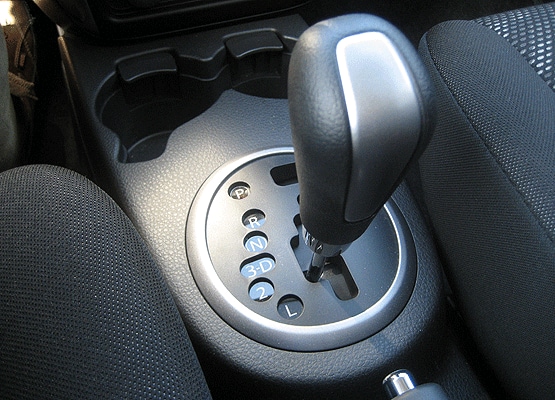
Here's were I was going to poke fun of Suzuki for equipping this car with an archaic 4-speed automatic transmission. I was going to make some bad jokes like, "A 4-speed? Cool, my IROC Camaro has one too."
But I'm not.
Turns out I like the automatic transmission in our long-term 2009 Suzuki SX4. Sure it's geared a bit tall compared to the more modern five and six-speeds out there, but it's responsive enough that the gearing isn't a problem. This thing is never lazy with a throttle induced downshift, plus you can choose the gears yourself with this cool gated shifter.
Obviously designed by somebody like me, a guy that likes to shift his automatic manually, the Suzuki's simple shifter is proof that the manual gate found in most cars these days is nothing but marketing. In the old days (you know, the sixties, seventies and eighties and even the early nineties), every Mercedes had a gated shifter much like this. Even the 1992-1994 Mercedes 500E/E500, which is one of my favorites, had one. It worked then and it works great now.
No I'm not kidding. Look, you slide it to the left for the first gear down and pull it back for the second. Each shift, up or down, has a hard stop. Brilliant. Plus the shifter's action is nice and tight, as are the gear changes.

The Suzuki SX4 may not be sexy but it gets the job done. Grocery getting and commuting are handled with ease and the interior remains fairly quiet even on the freeway. I also like the cargo cover that keeps whatever you have behind the rear seats out of sight.
The weak point is the four automatic speed transmission - it needs a five speed. There's just too much hunting at about 40-45 miles per hour. It's especially bad in slow traffic - a little on the gas and it down, then upshifts EVERY TIME.
A base wagon with navigation (like ours) has a starting price of about $16,000. Add a five speed auto and I'd say get this 'zuki instead of a Honda Fit.

I'm still reveling in our Suzuki SX4's high-tech features. While I don't exactly need a navigation system on my daily commute (I've driven this route approximately 3,000 times in the past 7 years), I like having the screen up for several other reasons.
First, I like seeing my relative position to upcoming landmarks. Second, I love how it tells me the upcoming cross street (even when it's not in route-guidance mode). Third, it's cool that it knows the existing speed limit on whatever stretch of road I'm traveling. Finally, it tells me my current speed and direction of travel.
Again, this is all default information provided by the Garmin unit without hitting a single touch-screen button. For tech geeks (like me), that's pretty cool. To have it provided in a sub-$20,000 economy hatchback? Impressive!

I love that our Suzuki SX4 Crossover has satellite radio. Kid Space Live has saved my fanny more than once on a cranky drive home from day care with a toddler who's had a long day. I just wish that the SX4's radio display screen gave me more than 10 characters of information about the artist or song that's being played. The Toddler asks, "Who is singing this song, mommy?" I reply, "Dinosaur R-something, um, I'm not sure what they're called."
I realize that they've got limited real estate on the screen, but there's space for a couple more characters on there, don't you think? I recall systems in other cars with similarly limited space giving you the option of pushing a button or turning a knob to scroll through the rest of the text, but I couldn't find the same functionality in our SX4. Obviously, it's not a problem unless I'm broadening my horizons and listening to a genre of music I'm not already familiar with. Guess I'll just stick to First Wave.

My colleague Josh is rather discerning when it comes to armrests. If it's a thinly padded deal, he'll call it out. I'd hate to think of what he'd say if he saw the SX4's! Although I have no complaints with the rest of the Suzuki's cabin — it seems well put together and is attractive enough, though like most economy cars it is comprised chiefly of hard plastic. But for the armrests?!
Suzuki needs to take a lesson from Hyundai here and realize that the areas of a vehicle that people come into constant contact with ("touch points" in car design lingo) should be finished off. They should give an impression of quality, not one of "did they forget to install the padded armrest tops here?"

When I put in a request for a car with some cargo capacity to take to San Diego last night, I won't lie to you, the SX4 wasn't at the top of my list.

The situation was, I bought a car last Friday — the 2001 Prelude mentioned here — and the only thing wrong with it was the ridiculous HKS Drager cat-back exhaust. You know, the kind that makes a deafening fart-can roar when you're trundling through town at 3,000 rpm and then quiets down once VTEC hits. That's unacceptable, so I started looking around for alternatives on Monday afternoon, and conveniently enough, a guy in San Diego had just put up a Craigslist ad for an OEM 2001 Prelude exhaust (it's in the Greddy box in the picture). We agreed on 40 bones and a Tuesday evening pickup — and I needed a car that could carry something six feet long.
Enter the SX4, a car I hadn't yet driven, and didn't really care to. I knew it had an '05 Jetta TDI-like 0-60 time without the low-end torque, and I knew it was a bargain-bin economy car with a four-speed automatic, and...well, what else did I need to know? A lot, as it turns out. The SX4 is a genuinely likable car. Detailed road trip impressions below.
Biggest surprise: the SX4 is a champ of a highway cruiser. I thought it would be noisy; in fact, both road and wind noise are impressively low. I thought it would have a jittery ride, but no, it's smooth and composed. Throw in a relaxed top gear (3,000 rpm at 80 mph) that somehow squeezes enough out of the wimpy 2.0-liter four-banger to climb most freeway grades without losing speed, and what you've got is maybe the most pleasant long-distance runner in the econocar class. I can't remember the last time a budget box like this lulled me into thinking 80-85 was 65-70, but it happened repeatedly in the SX4.

In other words, the cool and collected SX4 is the antithesis of the high-strung Honda Fit . I like its steering better, too: there's a pleasant weightiness to it at speed, and it's remarkably responsive, evincing negligible yaw delay. Pity, then, that it lacks the Fit's combination of relatively eager acceleration and good fuel economy and range. That's clearly this car's Achilles' heel — it just doesn't have enough power, and the fuel economy and range are pathetic (gas light came on after 215 highway miles, and eight miles later it drank 9.5 gallons for an average of 23.47 mpg).
Still, the SX4 was an unexpectedly pleasant road-trip companion, and of course it swallowed the old Prelude exhaust without issue once I folded the rear seats and reclined the front passenger seatback. Give this thing a motor and a manual transmission, and I'm sold.

There's a lot I like about our long-term 2009 Suzuki SX4, but its color is not one of them. Whoever chose it should be killed...twice, then we should all go after the fool's family.
Yes, it's that bad. But even covered in that horrific robin's egg blue (or is that seafoam green), I like the way the Suzuki looks. Park it next to a Honda Fit or a Nissan Versa or any other little econo wagon of the kind and I believe the SX4 is the hottie of the group. I like its bulldog proportions, its aggressive wheelwell flares and I like how its sits on those oversized 5-spoke wheels. It's the only car in its class with any stance and I think it looks far more masculine than its competition.
Paint it black, or silver, or any other boy color, and a guy can drive this thing without a bag over his head.
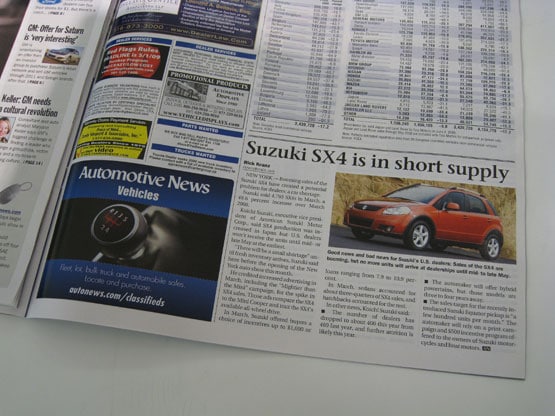
According to the most recent Automotive News, "Booming sales of the Suzuki SX4 have created a potential problem for dealers: a car shortage." March sales of the SX4 reached 4,795 units. That is up almost 50 percent from March 2008. The shortage is expected to last until new vehicles are shipped to the U.S. mid- to late May.
I wonder how much we could get for our SX4 on craigslist...


Well, our 2009 Suzuki SX4 cleared 5,000 miles last Friday. It happened about a mile short of the McDonald's on Castaic Road just off the I-5. To celebrate, I stopped and bought a Coke.
It will be interesting to see how easily our SX4 racks up miles for the remainder of its stay. The Honda Fits we've had in the fleet have always been popular (96 posts and 25,000 miles for the 2007 car), yet the milquetoast Nissan Versa (50 posts and 16,000 miles) was treated like it had a really bad BO.
I'd like to think that the SX4's mildly playful demeanor will help it be more endearing to our staff than the Versa.

Front seats don't get much more basic than the ones in our 2009 Suzuki SX4. They have manual sliding fore and aft and manual seat recline. No lumbar, no ventilating, no butt massaging (unless you do it yourself). And you know what, the seats are just fine without all that stuff.
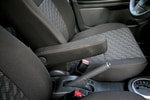
Since I haven't done more than a two-hour stint at a time in the Suzuki, I can't say how they'd be on a long road trip. But the seats are perched up high — sort of like an SUV's — and that provides good thigh support. Lateral support is adequate for this kind of car. The seat cushioning is a little spongy, but you do get an inner foldable armrest for each front seat, which is quite nice. Curious that Suzuki sprung for this but didn't think to put any padding on the door armrests .
The main comfort issue (for me) is the lack of a telescoping steering wheel. Since my legs are long, I have to position the seat either for my arms or my legs, meaning either I'm cramped or my arms extend out like a dude riding a motorcycle with ape-hangers.
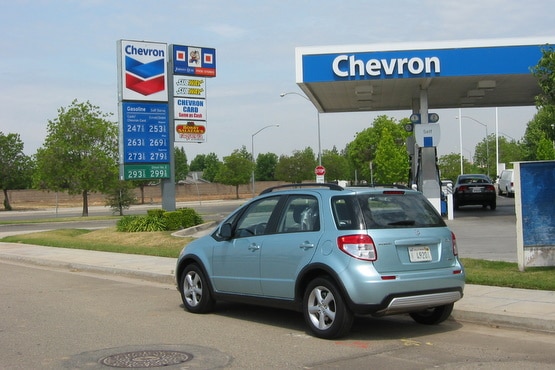
Yep, it's an issue. As Kurt mentioned early on, our SX4 throws in the towel after about 200 miles and flips on its low fuel light. When this happened a couple days ago, I felt like I had just refuelled the car the day before. Which I had. I just couldn't work up the effort to fuel up again, so I drove around for a couple more days with the fuel light on. Will I run out of gas? Ha ha, bring it on SX4 — I live for danger!
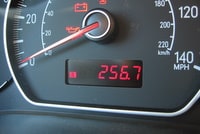
Actually, I gave in today and gave our little SX4 some sweet 87-octane nectar. Alas, I was not as reckless as I had thought — I only pumped in 10.2 gallons; the tank lists at 11.9 gallons. Still, I managed 256.7 miles on this tank, the most anyone on staff has gone so far. It also equated to 25 mpg, the best fuel mileage we've gotten so far. Which, depending on your opinion about such things, may or may not seem all that good.
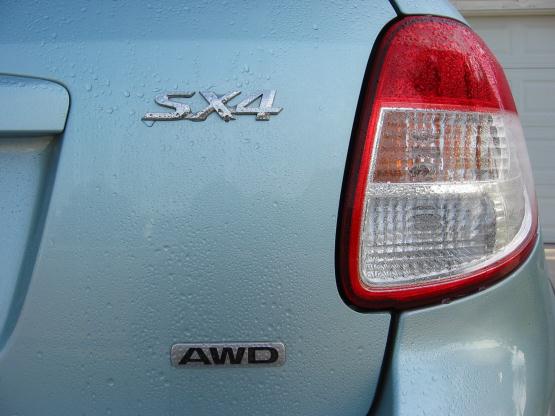
It rained last Friday while I was out in our Suzuki SX4. Seeing as how rain is about the most extreme precipitation Southern California gets, I figured it'd be a good opportunity to test out our Suzuki SX4's all-wheel drive. The experience, I must say, was rather underwhelming.
The SX4 has selectable AWD (which in my book technically makes it four-wheel drive, just so you know.). For normal driving, you can put it in front-wheel drive or in automatic AWD — for auto AWD, up to 50 percent of the engine's torque is applied to the rear wheels when front-wheel slippage is detected. There's also an "AWD Lock" position. Here, 30 to 50 percent of engine torque is constantly applied to the rear wheels. Suzuki recommends this setting for truly slippery conditions when driving at low speed.
While I still stand by my earlier argument that AWD is an advantage on wet roads if you're driving high-performance cars like our Evo, STI and GT-R, there's really no point to having an AWD SX4 if it's just raining. You're not exactly in need of extra traction during acceleration when there's just an automatic-equipped 143-horsepower engine under the hood.
The only time I actually got the rear wheels to engage was when I turned off the stability control and booted the throttle while exiting a slow-speed corner. Sure enough, the SX4 powered its way through the corner rather than spinning up its front tires with useless understeer. Fun? Sure. A common experience for the average SX4 buyer? Not so much.

Maybe somebody will take our SX4 up to the Sierras this winter for some skiing, in which case it might get further tested with some snow. Or maybe I'll suggest to Oldham that we have the entire editorial team move to Wisconsin. We could all live in one house, Big Brother style, and live off of cheese curds .
Obviously this is not our long-term Suzuki SX4, but it seemed relevant. I also think it was good that is was rated good.

Though almost all new cars now come with an auxiliary audio jack, the 2009 Suzuki SX4 isn't one of them. I use my iPod a lot while driving, so not having an input jack on our long-term SX4 has been a little disappointing. Thankfully, Suzuki does offer a regular input jack or a specific iPod adapter (stock photo below) as dealer-installed accessories. For the iPod adapter, though, I think the head unit's poor text display capabilities would hamper its appeal.

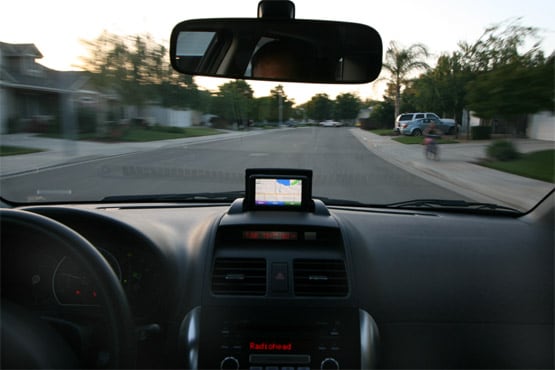
There's something about windshield-mounted portable navigation systems that just looks a bit goofy. When I spy another motorist with a black-plastic blob suction-cupped to his car's windshield, it's like he's proclaiming to me: "I have no sense of direction and I don't know where I'm going!" Might as well sign an "L" on your forehead, dude.
That's why I've come to enjoy our Suzuki's SX4's factory-portable Garmin navigation system. When you don't need it, it stays hidden. When you do need it, just push down on the dash-mounted lid to pop it up. It's
discrete
discreet and always-available navigation for the directionally challenged.

"Look Momma, the car is the same color as my backpack," she says.
I dig the Suzuki SX4, but might opt for a more grown-up color.

This pisses me off. Today our long-term 2009 Suzuki SX4 picked up this nasty door ding in its passenger side quarter panel. I'm not really sure when or where it happened, all I know is it wasn't there yesterday and it's there now.
It's this kind of thing that makes me question the future of the human race. If we can't even open our car doors without complete disregard for car parked next to us, how can we save our children's future? Sad.
Whatever, somebody out there has some bad karma coming their way.

Yesterday the airbag warning light lit up the instrument panel of our long-term 2009 Suzuki SX4. You may remember that this had happened before. It was an easy fix last time, hopefully it will be again. We'll let you know.

In this shot, you can obviously see that the Suzuki's airbag warning light is on, but so is the low fuel light despite the car having traveled just 215.4 miles on the tank of regular. Not good.

Lifting the hood of our long-term 2009 Suzuki SX4 I was half expecting to see the whole rat and wheel thing. I had been driving the Suzuki for a few days and most of my time in the car is with the throttle down on the carpet.
Yup, this thing is slow. In our track testing it hit 60 mph in 11.7 seconds (11.4 seconds with one foot of rollout like on a dragstrip). Trust me, when the light turns green flooring it is really your only option. And that's the reason we're often recording well under the SX4's EPA fuel economy ratings of 21 mpg city and 28 mpg hwy.
Fact is I had been ringing its neck so much I thought I'd be nice and check the little car's oil level. Which brought me to the lifting of the hood moment.
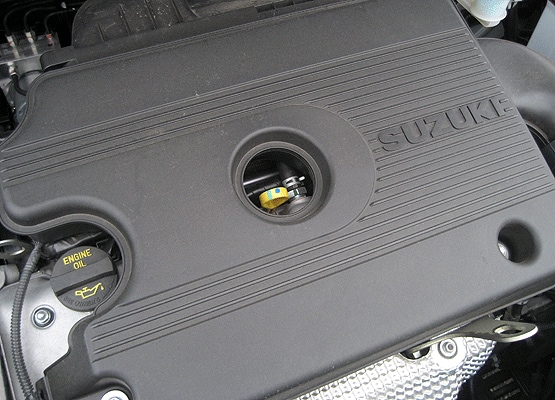
Surprise. There's a real life internal combustion engine under there, a device once seen as the savior of mankind. This particular example is a 2.0-liter four-cylinder producing 143 hp and 136 lb.-ft. of torque.
None of which is significant, but the ease in which you can check the powerplant's lubricant level is. Notice how Suzuki placed the dipstick front and center where it is easily found and easily accessed.
By the way, the SX4's oil level was fine.
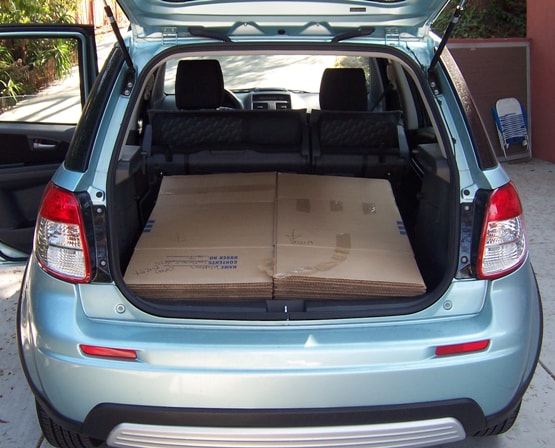
News flash: The Suzuki SX4's rear seats fold and tumble to accommodate a stack of cardboard boxes. What I didn't realize (until after a two-hour drive home wherein the rear seats would rock forward and smack the front seat every time I stopped in stop-and-go traffic) is...
...that there's a tether that was supposed to be affixed from the offending rear seat to the front seats' headrest posts to quell this charming cargo-hauling artifact.
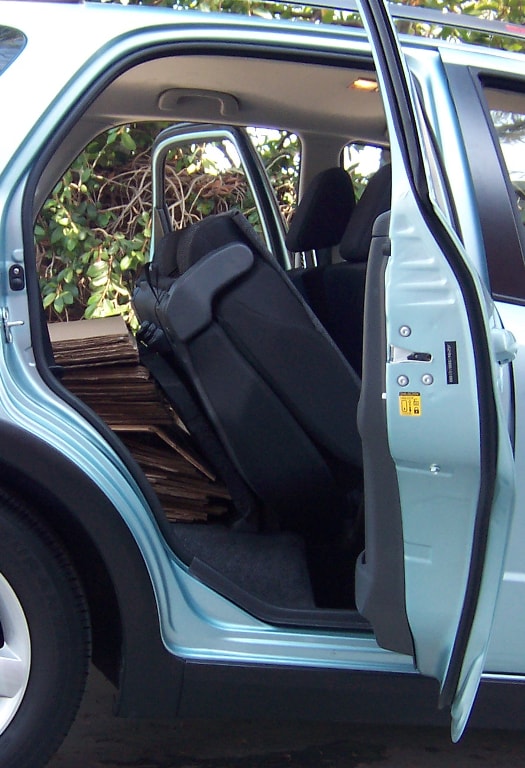
Next time, I'll try not to be in such a hurry to leave the office to get ahead of the traffic and RTFM. Another thing, the SX4's headlights are weak sauce. This morning when left home in the dark, I couldn't detect any difference between the DRLs and the actual headlamps except that the dash board lit up when I had the headlamps on.

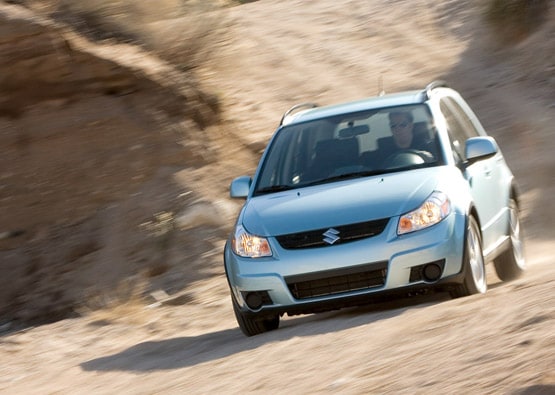
It may not be the quickest car in our fleet, but our all-wheel drive 2009 Suzuki SX4 will get you where you're going.
With 16 cubic feet of luggage space and maximum cargo capacity of 54 cu ft, it can carry a lot of stuff, too.
There have been mixed reviews on the paint color choice. But I happen to think it looks rather nice in Vapor Blue Metallic. And ours only cost $18,000 and some change with the Technology package.
In case you haven't guessed, our 2009 Suzuki SX4 is car of the week.
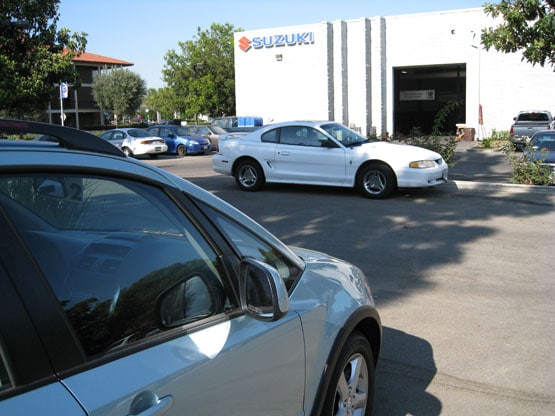
We reported the airbag light in our 2009 Suzuki SX4 was on for the second time. We were off to Cerritos Suzuki again. There at the same service department stood the same advisor we'd seen for the same problem the last time. The situation felt awfully redundant.
He extended his hand and said hello, but what we heard was a line from the classic Spaceballs, "So at last we meet, for the first time, for the last time." We had hoped this was the last time we'd be in for this airbag light. But no such luck. We had to come back.
We were told the cause of the light was a faulty switch in the passenger seat cushion and a new seat cushion had to be ordered. But the problem would not affect deployment of the airbags, our primary concern. "I'll have to order the cushion and call you," our advisor began. "I ordered one for another customer 2 weeks ago and haven't seen it yet. I'd expect 2-3 weeks before yours arrives."
From the looks of things, we'll be back at the dealer in about a month with Chapter 3 of the riveting airbag blog series to follow.
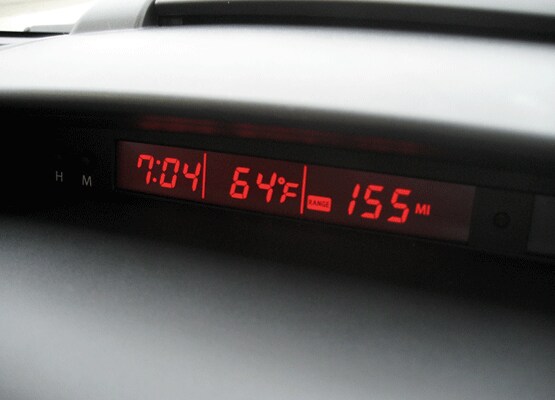
We've already extablished several times that our long-term 2009 Suzuki SX4 doesn't go very far on its small tank of fuel. Drive it like a little old lady and you're lucky to cover 200 miles before the low fuel light is glowing.
This blog post is not about that. It's about the SX4's range readout. This neat little luxury is rare in a car at this price point. I just checked, our long-term Honda Fit doesn't have one and I remember complaining that our $40,000 long-term Subaru STI didn't have one either.
You know, the more I use the SX4 the more I like it. It's packed with a lot of little things I'd appreciate if I were spending my own money on a car in this class.
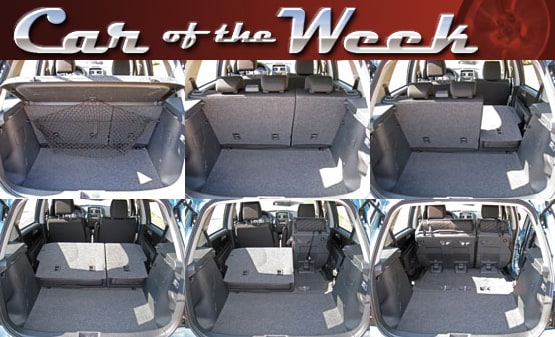
Since the SX4 is Car of the Week, we thought we'd settle the slowly evolving rear-seat coverage in one fell swoop. Though a short vehicle, the SX4 provides some pretty sizable and versatile cargo capacity for its length, thanks to it split folding/flopping rear seats. The standard cargo cover and optional webbed cargo net ($24.95) are just icing on the stowage cake.

When in full 5-passenger mode, the SX4 nets you a reasonably spacious and tall storage bin behind the rear seats. The cargo area cover sits high, level with the top of the lengthy seatbacks, and you're looking at enough space for most daily chores, including the week's groceries (what the cargo net seems made for). You could easily get a suitcase back here without folding the seats, but anything particularly long (golf-clubs, etc.), will require another mode.

Wax the cargo cover, and you've got a tall but narrow rear cargo area.

You can split fold the rear seats forward with the easily accessible handle on each end of the top of the seatbacks, which are a quick grab from either the rear doors or a mild stretch from the rear bumper. The headrests do not need to be removed, but it helps if you drop them to their lowest position. The 60/40 split rear seats can be folded forward individually, in no particular order.

With both seats down, you've got quick access to a larger cargo area, though it slopes significantly upward towards the front seats.

Both halves of the 60/40 split also flop forward individually from a hinge at the front base of the seats. This fully independent fold/flop is handy as you could have the large half of the split still fully upright, while a longer flat bit of load floor is created on the passenger side.
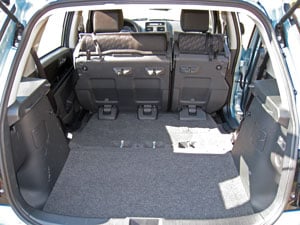
When the seats are flopped forward, an essentially flat load floor is created (it actually dips down a little bit where the seats bottoms would normally rest).
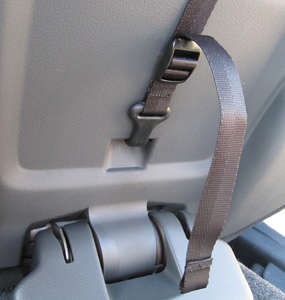
Once flopped forward, a strap artfully tucked beneath each rear seat bottom is revealed with its own little recess, which serves as an anchor point for the hook on the end of the strap.
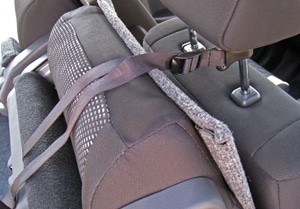
After you flop the seats forward, you can loosen this strap and then drape it up over the seat bottom and hook it to one of the front-seat head-rest support posts, which keeps the flopped seat tight against front seat backs.
When it comes to cargo versatility, the SX4 is pretty crafty...

There is a lot to like about our 2009 Suzuki SX4. It's cute (I know you don't all agree), it's comfortable, it has good visibility, satellite radio, lots of nice features.
But it's painfully slow. Excruciatingly, frustratingly slow. For tooling around town on city streets, that's fine. When running errands, it holds all my crap, groceries, dry cleaning, potting soil, anything you can think of. It's easy to park. Lots of pluses.
But forget it on the highway. Merging into traffic, foot down, and it takes its sweet old time. I find myself yelling at it to hurry the heck up. When you finally get up to a comfortable cruising speed, the SX4 handles it without much vibration and noise. But try to pass a Camry and it stubbornly climbs the speedometer at a snail's pace.
Argh.

I really like driving our long-term 2009 Suzuki SX4. No, it's not the quickest little hatch around, but its steering, brakes and suspension all have just the right weighting and feedback to keep me entertained. In fact, the Suzuki feels so good, there are several cars in our fleet with much higher price tags that could learn a thing or two from its brake feel, body motion control and precise steering.
Basically it's a car that likes to be driven hard, and it's a car that feels like it was tuned for the driving enthusiast.
Am I surprised by the Suzuki's pleasurable feel and entertaining dynamics? Nope. How could I be when the same company makes this...
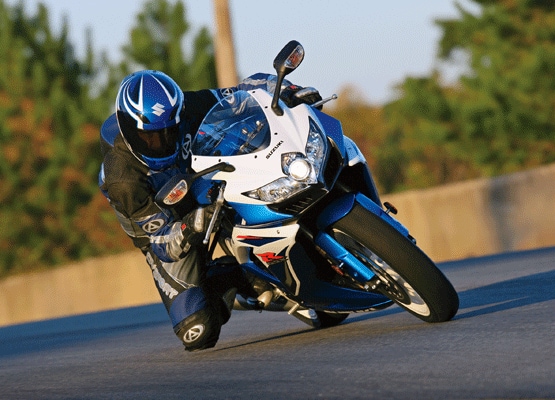
This is the 2009 Suzuki GSX-R600, and it is an engineering marvel. You think the SX4 is good value? Check this; the GSX-R600 costs $9,799, yet it packs an all-aluminum 599cc DOHC four-cylinder engine with a 12.8:1 compression ratio, two fuel injectors per cylinder and a 15,000 rpm redline. Also a 6-speed gearbox and an aluminum frame.
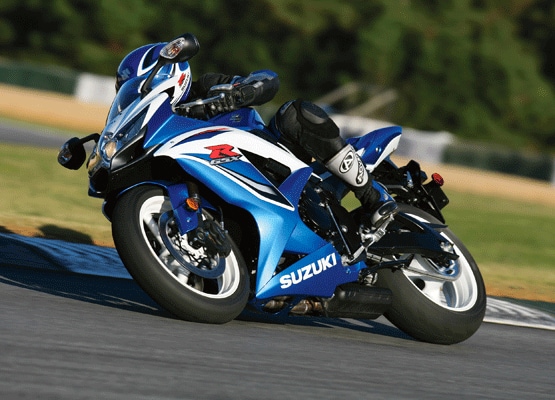
In a recent motorcycle magazine test it put down 105 hp at the rear wheel (it weighs just 432 lbs) and blazed through the quarter mile in 10.8 seconds at 128 mph.
Can you say GT-R who?
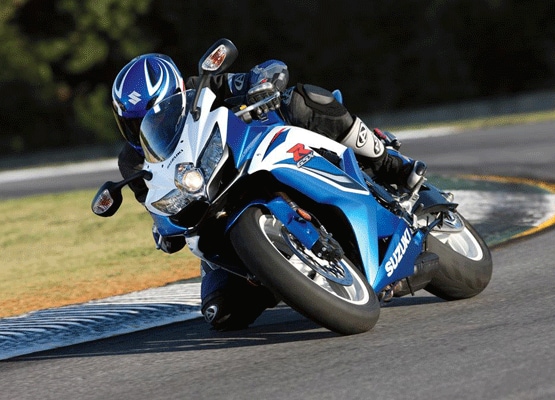
And this is the small bore version. Suzuki will gladly sell you a GSX-R750 or a GSX-R1000. And if you're really into fast they've got the 1300cc Hayabusa model.
Um, I wonder if that 1300cc motor fits in the SX4 like it does in the Smart.

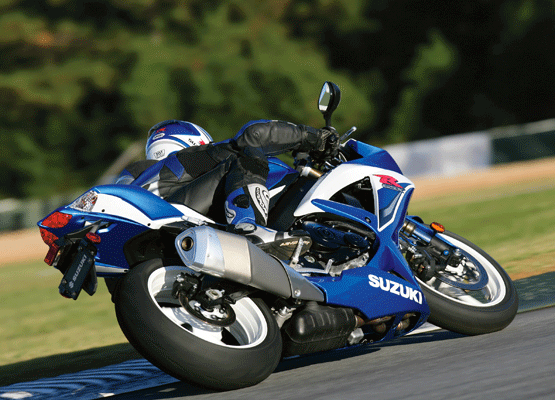
By the way, that is me knee down in these photos, pulling every last bit of performance from the GSX-R600. And if you believe that, I've got some Iowa ocean front I'll sell you cheap.

OK, let's clarify. Our long-term 2009 Suzuki SX4's built-in but portable Garmin Nuvi unit has nowhere near the features of the iDrive navigation system in our long-term 2009 BMW 750i. But this Garmin unit is better in two basic ways.
1. Unlike iDrive, the Nuvi tells me the side of the street on which I'll find my tall nonfat double latte fix. When driving in areas in which I'm truly unfamiliar, this is inherently safer, because (a) I'm not looking every which way to find my destination; and (b) I can get in the proper lane to turn into my destination.
2. I like voice instruction. I always turn it on when I use navigation systems. And I appreciate it when a system gives me directions in plain spoken English, pronouncing street and highway names pretty close to the way I'm used to hearing them. The Garmin does that well, even in the Australian male "Lee" narrator we've selected on ours — he can even say "Starbucks." Not only is the 750i's iDrive unit too infrequent in providing voice prompts, it can't pronounce freeway names in typical American parlance.

As Donna falls out of like with our 2009 Suzuki SX4, I think might be falling into like. I'm a long-time Fit fan and, up until today, I've never been able to get enthusiastic about the slow and heavy SX4. But after logging 130 highway miles, I think there's definitely something to the reports that Suzuki's hatchback might be the better highway car.
The SX4 outweighs the Fit by 450+ pounds, so it's no surprise the Suzuki feels more substantial and stable at 70 mph. And when you're in a very small car, but don't necessarily want to be driving a very small car, this is inherently comforting.
Also, when you're cruising down the highway, the SX4's steering is less reactive than the Fit's, with a stronger self-centering tendency, so you make fewer steering corrections.
Adding to the relaxation is the lack of engine noise at a cruise. But the arduous process of getting up to speed takes away some satisfaction. It's the classic scenario of not enough engine (a 143-hp 2.0-liter I4 lugging 2,982 lbs) and less than ideal gear ratios, and it's nothing you haven't experienced if you've driven any small car from the 1980s (or, yes, yes, our long-term Smart). And while not unbearable, the SX4 feels like a throwback — perhaps to the Corolla All-Trac.
But recalibration of my right foot has begun, and I've started to take full advantage of the shifter's D-3-2-L setup. So perhaps even this annoyance will fade. I'll let you know Monday.

After a 250-mile weekend in the 2009 Suzuki SX4, these gauges could be a deal breaker. Two problems:
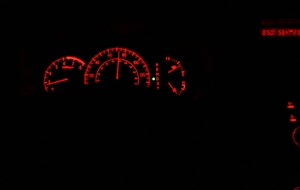
1. The gauges look orange-ish in this photo, but make no mistake, they light up in bright red. There is no relief from this color scheme, save for the green dot (amber for R) for the automatic transmission's gear selection display. It turns out monochromatic red is very hard on the eyes at night.
2. Excessive markings on the speedometer. I don't need to be able to tell a peace officer, "Why, yes, I was going 71 mph." The old "about 70" answer will do just fine. Having all these markings makes the gauge pack unnecessarily chaotic — the speedo looks like a protractor. A mark every 5 mph would do just fine.
P.S. We're not ignoring the airbag warning light. We're still waiting on a replacement driver-seat cushion from Cerritos Suzuki, and as we reported, the dealership maintains that the airbag remains functional and capable of deploying in a collision.
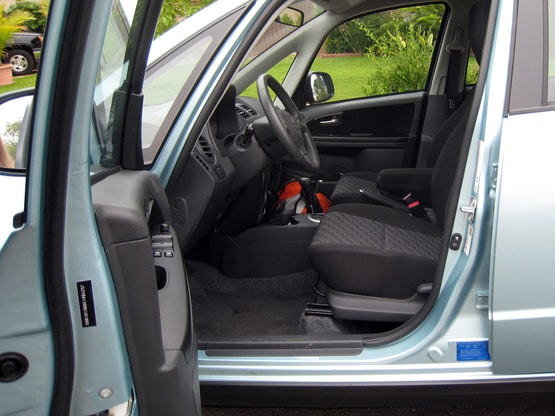
Our long-term 2009 Suzuki SX4 hatchback has a very tall seating position, even by small 'n tall hatchback standards. The car sits high off the ground (6.9 inches of ground clearance, apparently) and, as you can see, the driver seat is then mounted high off the floor.
Getting into this car requires no bending or crouching whatsoever from the average-size adult, but for the slightly klutzy, the exposed seat track poses a hazard.

I tripped on the track while getting in over the weekend.
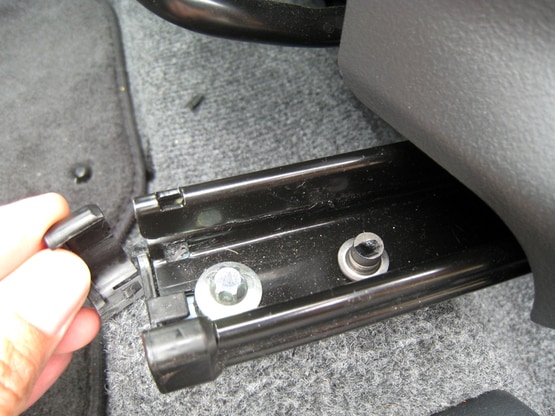
In the process, I broke off a piece of the U-shaped plastic trim that's supposed to protect you from the sharp edge of the metal. It can't be reattached. We'll need to get a new bit of plastic from the dealer if we decide we care that much.
A full plastic guard to cover the exposed track would make for a safer entry here, but Suzuki was no doubt seeking to trim costs on this $18K car.
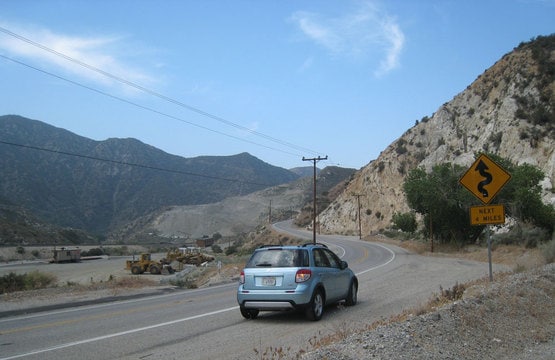
After a long weekend with the 2009 Suzuki SX4, I feel compelled to chime in with our editor in chief. I wasn't sure I wanted to drive our SX4 through any turns, because I thought the body roll would drive me crazy.
But it didn't.
At a comfortable pace (and with the SX4's lack of accelerative pop, "comfortable" is about all you can manage), the hefty little hatch turns in smartly, exhibits good balance with minimal roll and offers a nice weightness through the steering wheel. The experience bordered on fun. Mind you, on this road, I'd still prefer to drive our long-term Honda Fit, because it tops the Suzuki in sheer spunk (probably because it weighs 450+ pounds less).
I couldn't help but thinking how much potential there might be in the SX4 if Suzuki wanted to spend money developing the engine and chassis. And actually, Road Race has already developed a turbo kit for this car. And, as several of you have noted, there was a full-on rally version of the SX4 hatchback right up until Suzuki pulled out of WRC for 2009.
And speaking of WRC, Suzuki's motorsports division has a superb photo and video gallery from the 2008 season. Lots of photos after the jump.


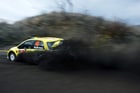


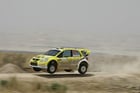

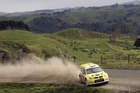


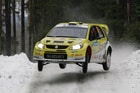

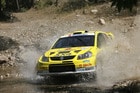
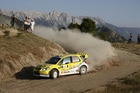
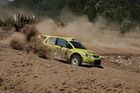

Suzuki's motorsports site has even more photos and video from every single stop on the 2008 WRC schedule.

It's been 3 weeks and nearly 1,000 miles since the dealer ordered a new seat cushion to correct our falsely illuminated airbag light, and still nothing.
At this point, the IP will look strangely unfamiliar when the light is off.
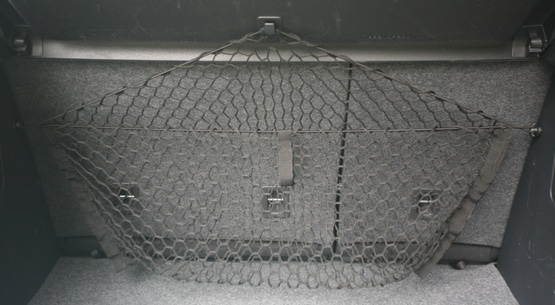
I don't usually use cargo nets (unless the chasmal space of a trunk requires me to if I want to keep my eggs intact and my berries from scattering), mostly because the inevitable fumbling to find the net's opening makes me feel like an amateur vaudevillian looking for the split in the stage curtain.
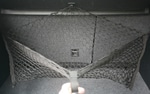
But behold! Our Suzuki SX4's cargo net has a handy pull-tab to make opening it a snap. Hurray for simple design improvements that make life easier. I also like that the net's at the back of the cargo area, keeping it conveniently out of the way when not in use, rather than closer to the hatch opening. No more catching stroller handles on the net as you drag it out of the cargo area.
And, a follow-up side note on the SX4's audio system display issue I mentioned a while back: Commentor steve196, I've tried holding down the "DISP" button to get song titles et al. to scroll, and it hasn't worked for me. Could be that I'm just lame, but I've tried a few different times to no avail. Can anyone else attest to this working for them and prove that I am, in fact, lame?

The 2009 Suzuki SX4 has these cool front quarter windows that can help you get a bead on surroundings. But as I discovered doing laps in downtown Long Beach this weekend, when making turns in the midst of a crosswalk grid, the front A-pillar is thick enough to hide a marching band from view.
The small triangular window (remember when those used to open?...) does create a useful port especially when glancing to starboard in traffic, as the angle when looking towards the passenger side gives you a more direct view through the transparent wedge. It's also very useful when looking for the curb when parking on one-way streets. We can probably thank the latest crash standards for these designs, as with small cars, pushing the dash forward and bracing it with a stout A-pillar probably does wonders for occupant protection.

When making a series of turns in a downtown grid however, the fat forward A-pillar is impressive in what it can conceal in the crosswalk, and I found myself bobbing and weaving my head to make sure I wasn't blindly running down a baby stroller or half a scouting troop. The Fit has this same design cue (left), but I don't recall the blind spot being as noticeable.
The Fit's A-pillar looks wider than the Suzuki's, but I've yet to run it around on the same downtown grid. In either, extra care around crosswalks and pedestrians is worth noting.

If you have any interest at all in the imminent arrival of Fiat in the U.S. under the umbrella of the reborn Chrysler Corporation (or is it the other way around?), you don't have to look further than the Suzuki SX4.
The SX4 is the product of a co-development project with Fiat, and the plant in Hungary that assembles this Suzuki for Europe also builds the Fiat Sedici. This Fiat is the most popular all-wheel-drive crossover in Italy. (Sedici translates as "sixteen"; 4x4, get it?)
So it's no surprise that the Suzuki's elegantly drawn exterior and practical yet stylish interior look as if they're straight from one of the leading design houses in Italy, as Giorgetto Giugaro's ItalDesign did the work.
Compared to the turgid appearance of pseudo-crossovers like the Dodge Caliber and Kia Rondo, the SX4 is a miracle of good taste. It makes practicality seem smart instead of cheap. It's Italian.
More small vehicles that look as good as the Suzuki SX4 would be a good thing.

Ever have one of those days when you feel like the whole world is against you? Well I had that every day I was in our 2009 Suzuki SX4 this weekend. Every day I had someone go out of their way to cut me off. From Ford Explorers to Kia Spectras to even Toyota Priuses. It was uncanny. Every time, whether there was a merge lane when it was my turn to merge FYI or I was just driving in rush hour traffic, the other driver would duck in front of me, nearly slicing off the SX4's nose. And of course when I honked at them "Hey, I'm driving here," I'd get flipped off. Every. Time.
Now before you say that that's just how L.A. drivers drive and I shouldn't take it personally, there was this one BMW 135i convertible with a "WRKMGC" vanity plate.
I was driving on Walgrove Avenue toward Santa Monica. A road I usually take to work. But since it was a Sunday and there wasn't much traffic on the road, I was just enjoying it and leisurely left about three car lengths between me and the BMW. But when we got to Ocean Park Boulevard where the road splits into two lanes only to merge again after the stoplight on the other side of Ocean Park, I signaled that I was going to turn right.
The BMW saw this and at the last second he straddled the two lanes and sat there at the redlight so I couldn't get around him. Huh?
When the light turned green, he creeped his way slooowly forward. So I honked at him to get going. Well, naturally he honked back at me. What a nimrod. What was his problem? I'll never know. But all the jerky driver encounters made me hate piloting this car around L.A. Not only because of that but also for its lack of power and its loud engine that revs to 4,000 rpm when you're going 65.
I think the Suzuki SX4 would be fine for the docile driver, someone who is tolerant and patient. OK, yeah, that's not me. But I've driven many different cars, cars you'd think people would dislike more, and have never consistently been hated on like I was in this car. It has a friendly blue-green color and is very innocuous-looking, why get in its face?

Sometimes, to get this Recaro kid seat to fit properly (it's the tallest child safety seat in the universe), I have to remove a car's rear headrest because it doesn't allow the back of the Recaro to sit even remotely flush with the seatback. But occasionally — as seen here in the SX4 — the head restraint isn't removable, and I end up having to cram the Recaro underneath the maxed-out head restraint to get it all to fit. This is why it's so important to take your child safety seat(s) with you when you test-drive a car.
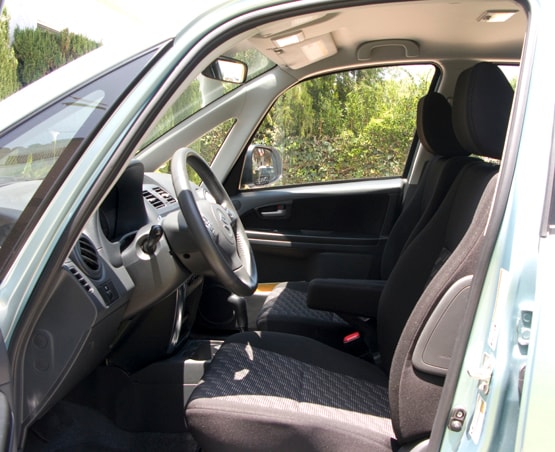
I'm kind of a visibility hog. I don't like wishing I could sit up taller in a car's seat so I can see what's happening around me, so whenever there's seat-height adjustment available in a car, I take advantage of it, even in SUVs. And though our long-term Suzuki's airy greenhouse gives the car a nice, open feel to it, without a seat-height adjustability, all that room above my head does me no good when I still feel like I'm sitting on the floor. It's something I've gotten used to, it wouldn't stop me from buying the car (I actually like almost everything else about the little crossover quite a lot), but I still wish I could be just a bit higher.
Also, a follow-up to my post last Friday about not being able to remove the headrest for child seat installation: Thanks, subaru123 for suggesting that I just tilt the seatback forward. That did the trick; instantly plenty of room to remove the headrest completely. Now I've got a well-installed kid seat.

This is a sad day in the world of Suzuki service. Over a month ago we special ordered a part to extinguish the airbag light on our SX4's dash. Our service advisor at Cerritos Suzuki informed us it would likely take 2-3 weeks for its arrival. That timeline had come and gone. So we contacted the dealer again.
"I'm very sorry, sir. Your order was suspended. You may want to order parts elsewhere."
Shocked as to why the order was cancelled and we weren't notified I dug deeper. What did order parts elsewhere mean? They owed us an explanation. But his polite, matter-of-fact response made me feel a little guilty for asking.
"Sir, parts are on hold because there is question as to how much longer this will be a Suzuki dealership."
Oh. Well, that sucks for everyone involved. Back to square one.
(And yes, that bench is as crooked as it looks)

As I was driving the SX4 home last night, I realized I really like this little hatchback. Lightweight, inexpensive cars like this sometimes feel lightweight and inexpensive on the road. Not so with the SX4 — it feels solid and composed in most circumstances. It's reasonably quiet, as well.
I even like the look of its cabin. This is an interior that makes no attempt to transcend its status — hard plastics abound, and there's not a lot to capture visual interest. Still, it works for me — the black-with-metallic-accents color scheme strikes me as masculine and kinda industrial-looking. And I like the simple, straightforward layout of the knobs and buttons on the center stack.
Overall, this is one very cooperative little hatchback — and cooperativeness is a big plus in this segment.

I'm not sure how, why or where it happened, but I drove our long-term 2009 Suzuki SX4 to Pomona and back (about 120 miles) this morning and I couldn't help but notice that the car's steering wheel has become cockeyed. When you're driving straight, the wheel looks like you're making a slight right.
We'll get it fixed when the airbag part comes in or at car's the next scheduled service, which ever comes first.
By the way, please refrain from commenting on my lame photo and/or hairy arm.

As I said yesterday, yesterday morning I drove our long-term 2009 Suzuki SX4 to Pomona, which is about 60 miles east of our Santa Monica office. And there are three things you need to know about Pomona.
1) It is the spiritual home of the National Hot Rod Association, which runs two national events there on the quarter mile strip at the Pomona Fairgrounds.
2) It is where you'll find the Wally Parks NHRA Motorsports Museum, which is run by a cool guy by the name of Tony Thacker and is definitely worth a visit.
3) It's freakin' hot.
And as you can see by the photo above the Suzuki was well aware. That's 93 degrees Fahrenheit on its outside temp readout.
Trouble was, to counter that I had to have the SX4's air conditioning on full blast and then it was only keeping me alive.
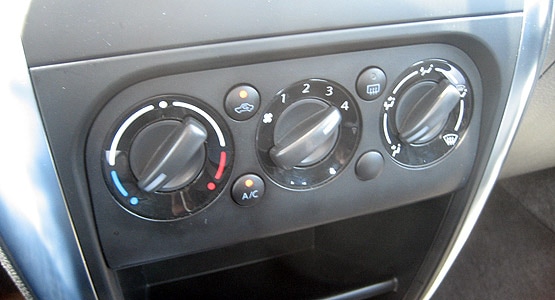
This is how I drove the 60 miles back to the office, with the Suzuki's A/C cranked. Just turning off the recirculation setting was to risk my life. Only when I hit Santa Monica and cloud cover of the coast (the outside temp quickly dropped to the high 70s) was I able to turn it back.
Considering the Suzuki's interior isn't all that big and the fact that I tend to like things on the cold side, I'd say the SX4's air conditioning is just okay. Not bad, but not great either. If you live where it's less than 90 degrees this won't be an issue, but for all of you that call Phoenix home, it's something to consider.

I grew tired of driving the SX4 on Saturday and decided to swing by the office to pick up "my sister's car" (Thanks Scott). But thanks to the SX4's removable Garmin navigation system, I was still able to find my evening's destination despite driving an 11-year-old roadster. There wasn't exactly a good place to put the thing, but the same could be said for a Thomas guide.
This is a fantastic idea for multi-car households, as I'm sure most folks could make due with only one navigation system split between two cars. It would certainly be a boon for folks who own an older weekend car. Obviously this goes for any store-bought, Garmin-style navi, but the fact the Suzuki's is built-in for a reasonable price (standard on the Sport) is an added advantage.
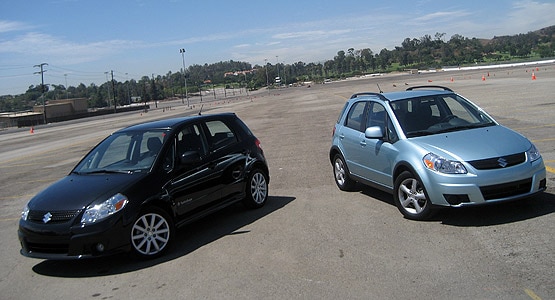
Several times I've posted blogs detailing my fondness for our long-term 2009 Suzuki SX4. I even said I would buy one.
Well, now I'm not so sure. Instead I think I would wait for Suzuki to get its 2010 Suzuki SX4 Sportback to market. I just had a chance to drive this new model, and it's really good. It's the black one on the left. Notice it doesn't have a roof rack like our long-termer. In fact Suzuki has turned down the car's SUV-vibe and replaced it with a much more desirable small performance car look, complete with a mild body kit, a lower ride height, a sport-tuned suspension, nice looking 17-inch wheels and lower profile Dunlop rubber.
And here's the best part: They gave it more power.

Under the hood is an all-new 150 hp 2.0-liter with variable valve timing, and it transforms the SX4 from slug to fast enough to get your attention. The engine works with either a new six-speed manual, which would be my personal choice, or an all-new and nicely tuned CVT with available paddle shifters.
And get this; it even gets better mileage. More than 2 mpg more according to Suzuki, and it has a larger fuel tank (2 additional gallons) to improve range.
They bettered the inside too, with a new backlit instrument cluster, a new center stack design, new climate controls and new fabrics.
You know, I still like our little SX4, but maybe I can talk Suzuki into letting us trade up when the new Sportback hits dealers in a couple of months.
Sure would be nice.

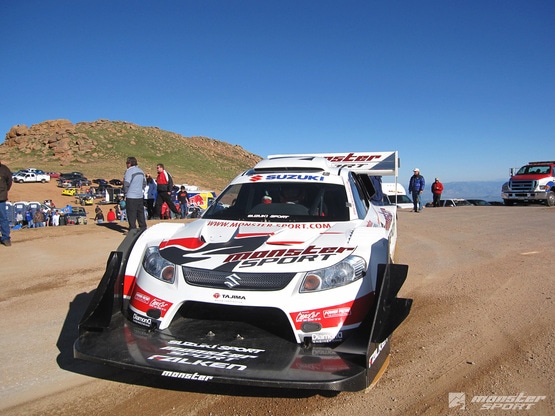
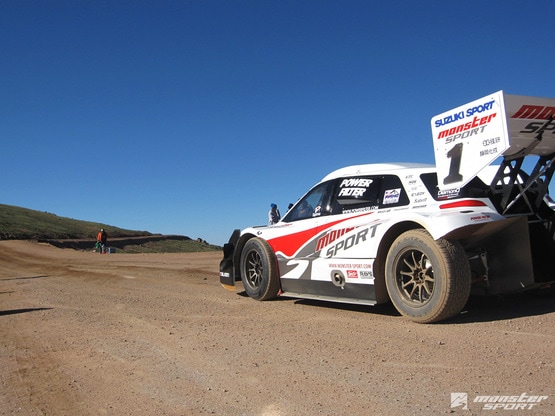
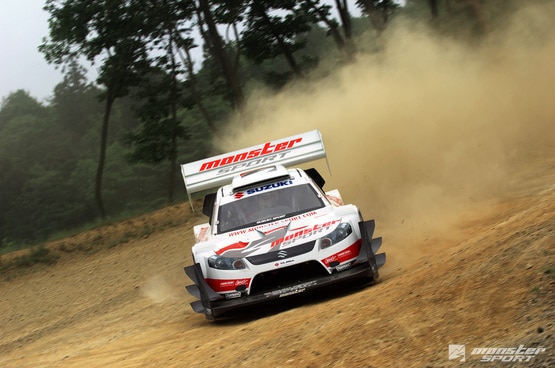
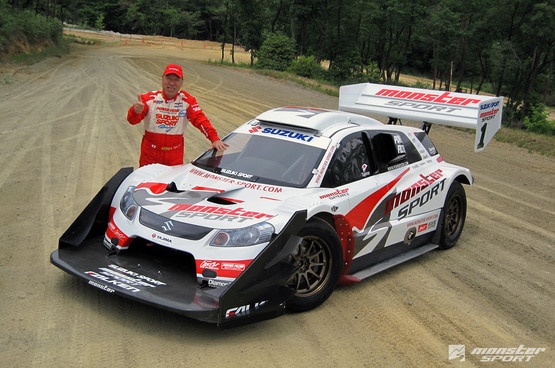
If the Pikes Peak Hill Climb was televised, who knows how many people would be all excited about the Suzuki SX4 today. After both Ford Fiestas prematurely expired during yesterday's Race to the Clouds, 20-year Pikes Peak veteran Nobuhiro Tajima jumped into his Suzuki SX4 hill climb special (prepared by his own team, Monster Sport) and ran a 10:15.368, easily winning the Unlimited class.
You can see the unofficial times here and full specs on the Monster Sport SX4 here.
It's an understatement to say this SX4 has little in common with our long-term 2009 Suzuki SX4 hatch. For example, instead of our long-termer's normally aspirated, 143-horsepower, 2.0-liter inline-4, the hill climb car has a twin-turbocharged, 2.7-liter V6 with dry sump oiling. Monster Sport gives hp and torque in PS and kg-m, but converted, they come out to a claimed 873 hp at 8,750 rpm and 654 lb-ft at 6,250 rpm.
More photos after the jump, plus the best of the videos taken by spectators standing along the course.
Edmunds News: Pikes Peak: Tajima, in Suzuki SX4, Notches Fourth Consecutive Win

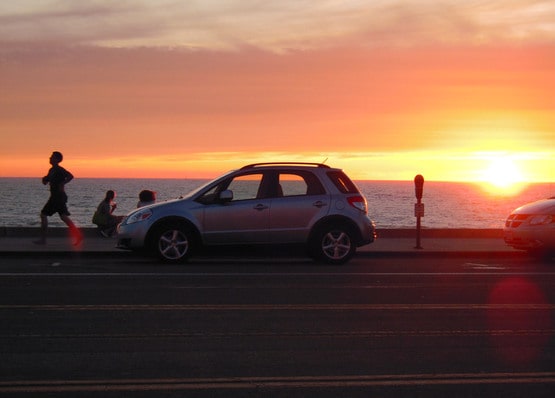
We had a spectacular sunset last night so I rushed to the beach to take some pictures of the Suzuki SX4.
The Suzuki SX4 is a pretty car anyway and it looks great against the backdrop of the Pacific Ocean.
If in some alternate future I was to purchase a Suzuki SX4, this would be my wish list:
- just a little more power (I know it's an economy car, I don't need to be blown away)
- quicker downshifts (so I can kick it when I need to)
- a moonroof (so I can enjoy the night sky)
- a kicking audio system (so I can disturb the neighborhood)
- some sun protection on all that glass (so my legs don't fry like they did on the way to work this morning)
More pictures after the jump...
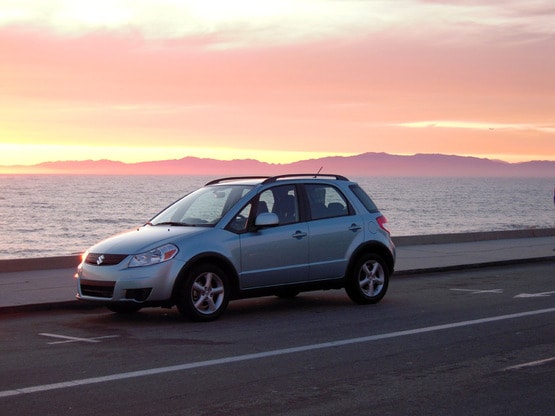


I realized just how much I hate regular radio last night. While facing a 45-minute, 11-mile drive to pick up my girlfriend, I was channel surfing FM. But my efforts to avoid obnoxious commercials and equally obnoxious DJs to actually find some music were mostly fruitless.
When I noticed the SX4's satellite radio button, I was psyched! But when I pushed it...no dice. Seems we don't have a subscription in force. "No biggie, I'll just plug in my iPod" I thought. But nope, as Brent pointed out, there's no auxiliary jack, let alone an iPod hookup unless you get it at the dealer. This is rather strange, considering the SX4''s other unexpected upscale and modern features (such as those handy steering wheel-mounted audio controls and the removable nav system). Sadly, without a CD at hand (remember those?) I was at the mercy of FM.

I like the simple to use, yet feature packed and removable navigation system that came standard on our SX4. The only problem for me is that it's nearly out of reach, perched as it is rather far away towards the base of the windshield. When I try to use it (after pulling over to the curb or into a parking lot), it was a stretch to put fingertip to touch screen. And this from someone who, at 5'-5", has the driver seat scooched up closer to the dash than most.
As the navi is portable, I would usually just disconnect it and chipmunk away at the screen, then put it back into its mount after I'd inputted my destination and motor away. Is it just me or was this thing designed for use by those with a Phelpsian wingspan?
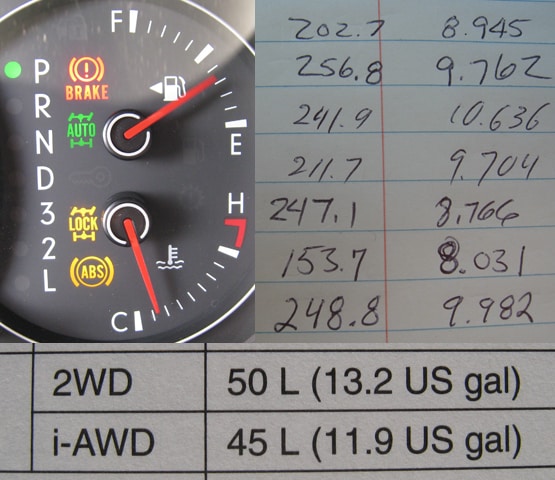
Our long-term Suzuki served shuttle duty this week, easily carrying me and a set of overnight luggage from L.A. to a press event in San Diego. I filled up the night before so I wouldn't have to deal with fuel stops on either of 130-odd mile legs, but then I forgot about the Suzi's limited range. Though the tank is smaller on our AWD model (11.9 vs. 13.2 gallons), I'm not sure if we're ever dipping into its full capacity.
The needle was below the "E" and the fuel light had been on for some time before I finally caved and hopped off the 405 in the midst of rush hour traffic to top it off. As you can see from our fuel log on the right (that's miles and gallons), our mileage has varied, but we seem unable to get within a gallon of the stated capacity, so maybe we've got a slightly pessimistic fuel needle. Better safe than sorry, but I bet I could have made it home...
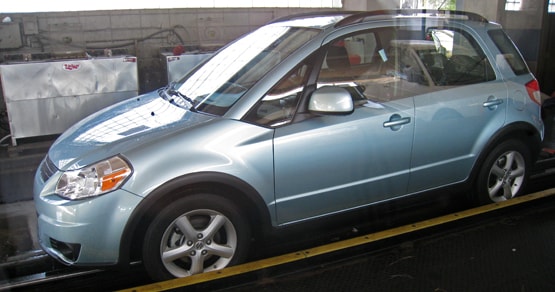
If there was no Honda Fit to fight for your dollar, we'd probably never shut-up about the SX4. It's all ate up with practical, and unlike the Fit, is available with all-wheel drive (AWD). Running errands around L.A. all weekend doesn't really require the AWD, however, and if you live where the snow is rare, you'd probably be perfectly happy with the FWD SX4 and its larger gas tank.
The heat was on this weekend, so the reasonably effective A/C was on full bore most of the time, and you notice the power sap especially when lounging away from lights. The Suzi also needed a scrub, and though not exactly the most butch color ever, the sea foam highlights do look best on the car when it's clean. The SX4 may not be the kind of performance car to boil you blood, but day to day, it's tough to beat for a runabout — save the Fit, which adds frisky to the SX4's otherwise stoic resume.

So Frank calls me yesterday and tells me that he's thinking about getting a Honda Fit. I ask if he is nuts.
Apparently the expense of commuting back and forth to the Valley in his Dodge Ram pickup is getting a little pricey, and he really admires the practicality of the Fit's interior packaging. You see, he wants to be able to carry an engine block when he has to.
That's because Ed Pink Racing Engines builds the Toyota inline-4 racing engine for USAC midgets, and the last time I was at the shop Frank also showed me a Toyota V8 NASCAR-spec engine, a turbocharged Ford-Cosworth V8 Indy-car engine (27 of them, in fact), a flat-12 for a Ferrari 512BB endurance racer, a V12 for the Jaguar XJR-5 IMSA GTP car, and the straight-8 from the first-ever Duesenberg passenger car of 1920. Hence the whole thing about carrying around engine pieces.
But I tell him that he doesn't want a Honda Fit.
The Fit is a brilliant car, but like me Frank has trouble with a driving position that's meant for Japan, a place where you don't often see an American-size guy with feet so smashed up from a couple of race car crashes (plus an unintended leap into a service station grease pit), that he's comfortable only in either cowboy boots or Simpson racing booties. If you like to drive with your legs outstretched as if you were in a racing cockpit, the Honda Fit is not for you.
When Frank suggests the Toyota Matrix as a possibility, I warn him off for the same reason.
Instead I suggest the Suzuki SX4. The same basic money buys you a far more comfortable people package, and the driving position is meant for those of the American-size persuasion. Plus you could carry not just one engine block, but maybe two.

Over the weekend I noticed that our long-term 2009 Suzuki SX4's hatch doesn't fit right.
Specifically, the gap on the right side is bigger...
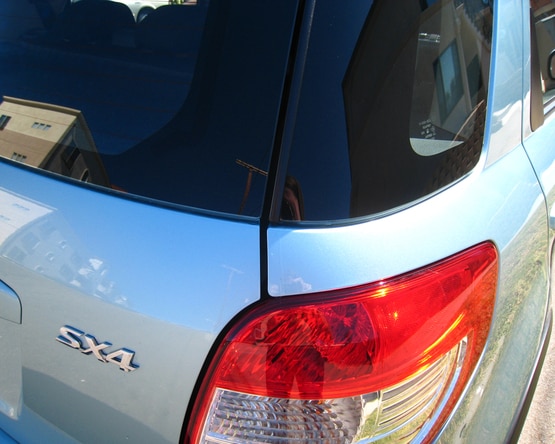
... than the gap on the left.
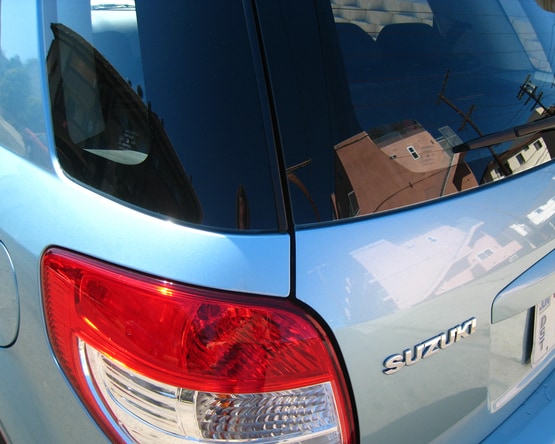
This would drive me crazy if I owned this particular SX4, but not as much as the fact that we haven't yet found a Suzuki dealer in Los Angeles that can fix the airbag fault light.
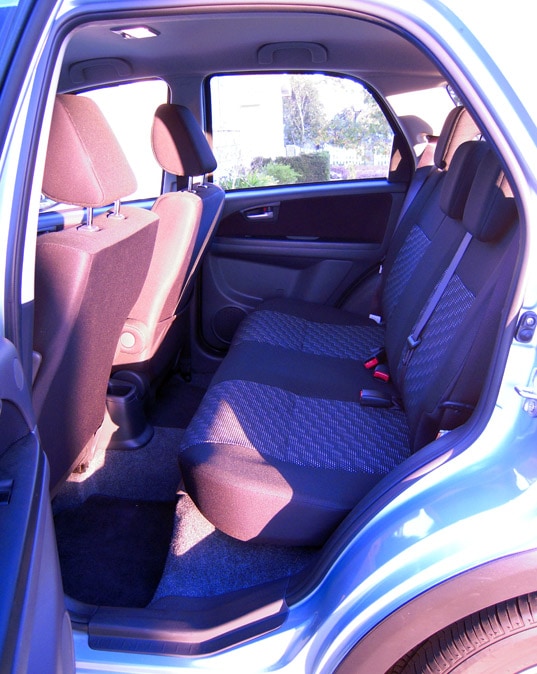
Me and the girls went out Sunday for a short little trip to do girly things.
I offered to drive as I usually do because they are always interested to see what car I'm driving.
This time I was piloting the Suzuki SX4. We had two passengers in the back seat so I told them it was their job to give me a back seat review.
They felt they had enough room but doubted that taller passengers would find it comfortable. "It's perfect for children in car seats," said one.
"It's nice and cool back here," said another. "The air conditioner reaches me just fine."
They also concluded that the car is much roomier than it looks from the outside. The cloth seats were comfortable, but for longer trips they wondered if they would feel cramped.
For our next outing, I promised to get a larger car so they could feel the difference.
Have you driven in a Suzuki SX4?

This fuel warning light came on right after I left my house this morning.
I live 20 miles from the office but I wanted to get to the gas station near the office because it has a drive-through car wash.
My old Chevy used to run out of gas right on the empty line. But my Acura will keep going for a while well below the empty line. I wasn't sure what the Suzuki would do, so I kept on driving.
Turns out I didn't reach the line before I reached the car wash. The 2009 Suzuki SX4 has a fuel tank capacity of 11.9 gallons. When I filled up, the car took in 9.228 gallons. So, I needn't have worried.
How low does your fuel meter go past empty?

Last week we got word that the online Suzuki SX4 club, SX4club.com, was having a first-ever meet at Suzuki's U.S. headquarters in Brea, California.
Since Suzuki HQ is located about 5 miles from my house, I figured I'd drop in with our 2009 Suzuki SX4 long term car and see if any of the club regulars noticed my party crashing.
About two dozen vehicles participated. Many were locals from So Cal, but several had come a few hundred miles from places like San Francisco, Nevada and Arizona.
As an online club, everyone more or less knew each other already. But many had never met face-to-face, so it took awhile for the participants to connect faces to cars to online usernames.
Our unmodifed i-AWD SX4 and its automatic transmission was in the minority. Nearly every club member's SX4 was modified in one way or another, and more than half were 5-speed manuals.

Some were lowered and had other bolt-on mods like drilled and slotted brake rotors.

A couple went for the rally look, with squared-off knobby tires. Another had a suspension lift kit consisting of spring spacers.
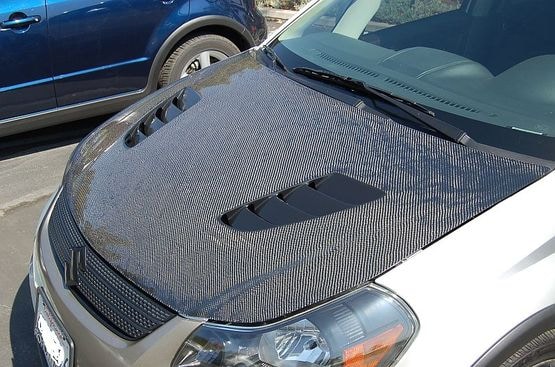
Carbon fiber was well represented in the form of hoods...

...rear spoilers...
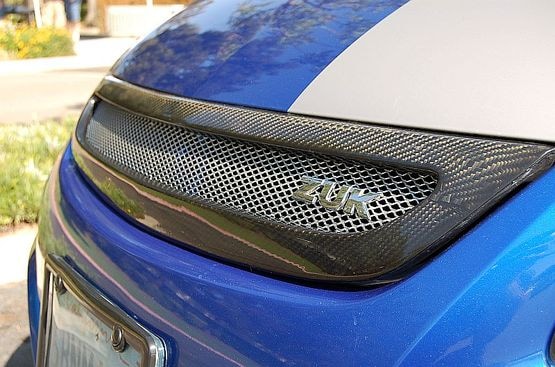
...even a grille insert, all available from an outfit called CarbonTrix.

Two of the SX4s in attendance were outfitted with a new Road Race Motorsports turbo kit that one owner said made just over 200 horsepower at the wheels on 10 psi of boost. That's over 60 horsepower more than our stock 2009 SX4 makes.
All in all, this first-time event attracted an enthusiastic and friendly bunch that really loved their Suzukis. It looks like the SX4club folks plan on doing it again next year, only bigger and better.
If this event was any indication, I'm pretty sure that party-crashing noobs will always be welcome.

I scurried away from our Santa Monica offices early yesterday morning to attend an automotive event just north of us in Thousand Oaks, CA. Leaving just after the sun rose, I was pretty much assured of avoiding any of our notorious L.A. traffic, so I decided to tackle my favorite roads above Malibu. These thin ribbons of asphalt wind their way up from the beach, high up into the Santa Monica Mountains, and back down the other side right to my destination.
The SX4 performed much better than I expected. It's steering was communicative and precise, the suspension inspired confidence and the brakes never faded. It was actually, dare I say, fun. One thing I did notice was its cow-like engine/exhaust noise. On the highway it emits a muted mmmmmmmmmoooooooooooooo. Downshifts sound more like a surprised cow - mmmmmmmooooOOOOOOOO! Hard acceleration made it sound like an angry cow - MMMMMOOOOOOOO!
Aside from the bovine histrionics, the overall driving dynamics challenged me to become a better driver. The lack of underhood power encourages go-kart-like driving in the canyons. Lose momentum and the engine bogs heavily. Saw away at the steering wheel and you scrub off even more speed. By the time I reached the other side of the mountain, I was driving smoother while keeping the SX4 in the power.
On a final note, when adjusting the tilt of the steering wheel, the column lacks support - either in the form of friction or weight-countering springs. Once you pull the adjustment lever, the wheel and column drop like an anvil. And boy, that thing is heavy. I'm not sure if something's missing or broken, but it definitely feels wrong. Granted, most owners won't be adjusting their wheel as much as we do in our long-term lot.

Our long-term 2009 Suzuki SX4 didn't get the suspension walkaround treatment the last time it was car of the week, but it wasn't my fault. Someone stole my car. There was an earthquake. A terrible flood. LOCUSTS!
But everything is all better now. The Suzuki is up on jack stands and it's not too terribly hot outside. Let's take a peek inside those wheel wells.

The SX4's front suspension is pretty standard compact car stuff: A MacPherson strut (white) and a rear-facing L-shaped control arm (yellow).
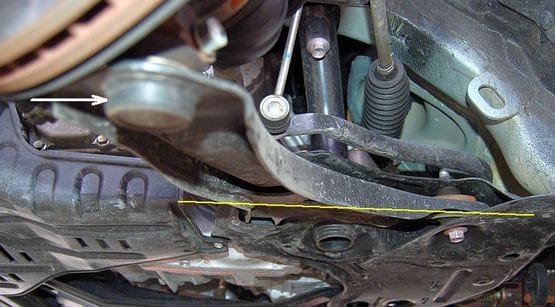
Of course the L-shaped lower control arm has a single ball joint. The dual-pivot setups we've seen lately need a pair of separate links to go with them.
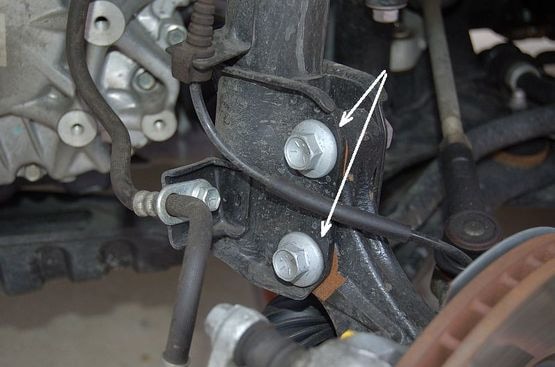
As with most strut set-ups, a pair of large bolts clamps the the strut firmly to the knuckle. There isn't any camber adjustment here, but loosening these bolts can yield small changes because of the clearances within. (Don't forget to re-torque them properly)
Many carmakers that use this type of connection also sell necked-down bolts that increase these clearances to allow for additional camber adjustment in the event of "crash damage". Don't know if Suzuki has these in their parts catalog, but I would not be surprised.
Any camber adjustment performed by loosening this connection will throw the front toe-in out of whack, so the toe needs to be reset after any camber adjustment is made, no matter how small.

The stabilzer bar is connected directly to the strut via a long, slender link (yellow). And if you think this rear-mounted steering rack looks a bit higher than usual, you're right.
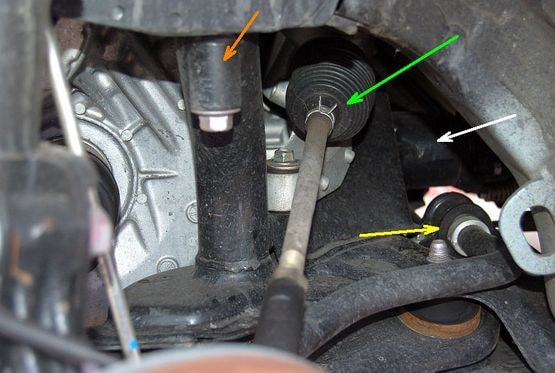
The steering rack (green) sits up high for one simple reason: the power take-off (white) that sends power to the rear wheels has dibs on the space. The stabilizer bar (yellow) may look like it makes a dead end at the bushing, but it's an illusion; in reality it dips down under the PTO housing.
Meanwhile, the front subframe uses a solid mount (orange) that stands clear of it all to make room for the overslung steering rack and underslung stabilizer bar.
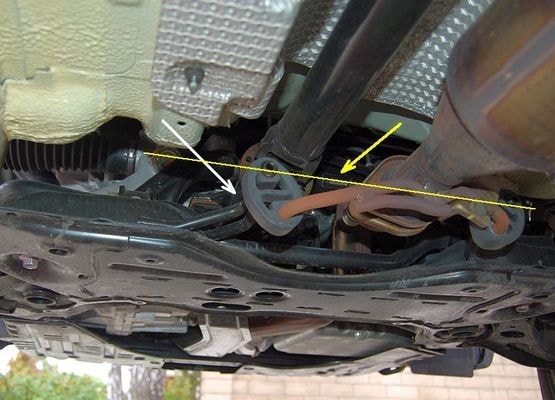
Here we can see the PTO housing (white) and propshaft emerging from beneath the steering rack (yellow).
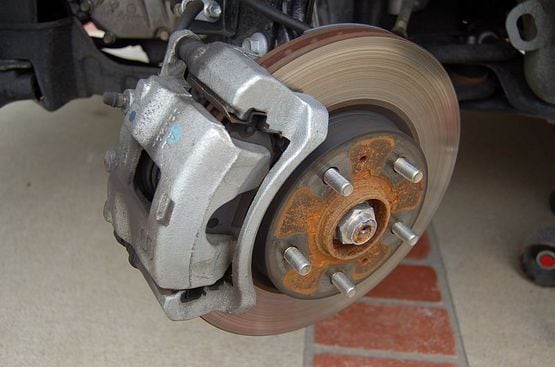
The SX4's front brakes consist of single-piston sliding calipers and ventilated rotors.
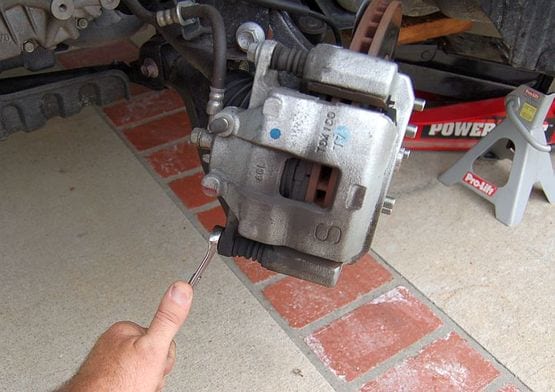
Sliding calipers like these are absolutely the easiest type of brakes to work on. Simply remove the retaining bolt on the lower slider...
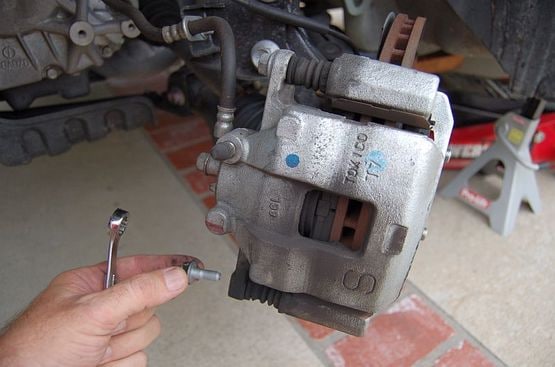
...like this, and...

...gently pivot the sliding half of the caliper up on the upper bolt, which you don't even have to loosen.
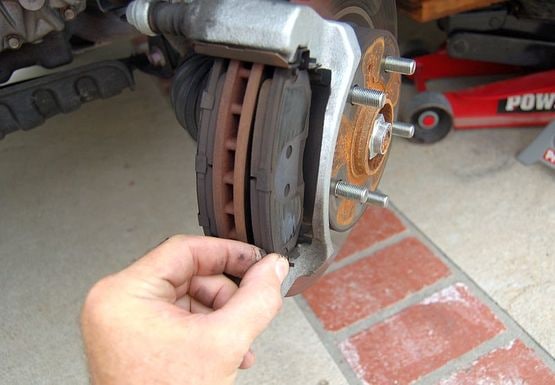
At this point the pads practically fall out by themsleves.
Of course this is a simulation. These pads are not thin enough to need changing.
If this were a real pad change, I'd go through additional details about shims, anti-squeal compounds and how to retract the pistons, just like I did on the Nissan 370Z fixed-caliper pad change. For now, know that this job is a fairly simple DIY that requires no exotic tools.

In back, the SX4 uses the same sort of one-piece semi-independent twist beam axle that we saw on the Honda Fit and Insight. It basically amounts to a huge, car-spanning stabilizer bar with wheels on the ends. What's confusing the view here is our AWD SX4's rear differential
This type of axle isn't a great choice for off-road vehicles because opposite-phase wheel articluation — the amount one wheel can go up compared to the amount the opposite one can hang down — is somewhat limited. And you can't really change it because a twist beam can only twist so much. We've all seen what happens when you bend a paper clip too far back and forth for too long.
But the SX4 isn't a full-blown off-road vehicle, it's a car-based SUV with all-wheel drive. A "soft-roader" intended for use in snow and on maintained fire roads. And for those purposes the twist-beam design works just fine.
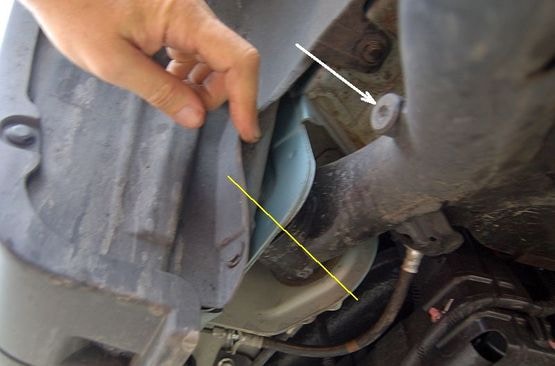
Like all such designs, the SX4's twist beam mounts to the chassis in just two places, one per side. The bushings are angled (yellow) to help them better cope with the combined need to deal with longitudinal road inputs and lateral cornerng forces.
The torsional stiffness of the cross-car part of the twist beam (the twisty bit) is brought up to the engineers' desired specifications by means of a permanently welded-in stabilizer bar (white) that runs inside.
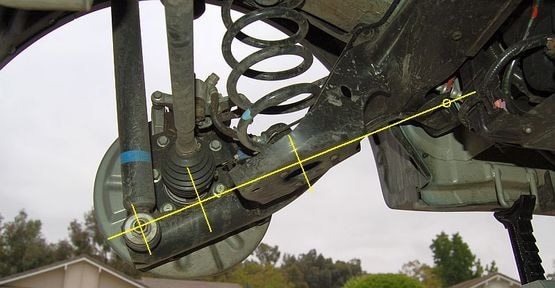
You've heard be go on about motion ratios before. With a twist beam, we don't look at the lateral lower control arm to determine these ratios — we look at the longitudinal "swingarm" portion of the beam instead.
This fact gives the twist beam a very unique difference: the shock absorber's motion ratio relative to the wheel can be greater than 1:1 because the shock can be mounted further away from the pivot than the axle. Here it looks like 1.2:1 or thereabouts.
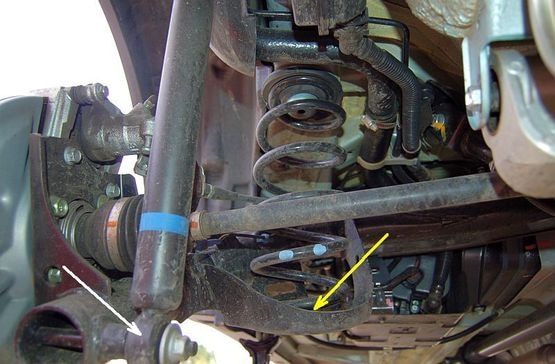
The shocks (white) are the only things keeping the springs secure in their lower seat (yellow). Remove both shocks while the back is off the ground and the axle can easily be pulled down far enough to remove the springs. Moral: If you jack up the rear to change shocks, change them one at a time.

The rear differential of the AWD SX4 hangs beneath the unibody, mounted separatly from the suspension. In fact the twist beam itself (white) has a gentle arc that's shaped to keep it above and out of the way of the diff.
The diff itself is mounted in 4 places (yellow). The rear mount is broad so that it can more easily deal with the torque reaction that comes when power is applied from the propshaft (aka driveshaft).
The forward part of the housing contains the coupling that distributes power to the rear wheels in i-AWD or AWD-lock mode, and various wires (black) run inside to control the mechanism.
Of course this means that the propshaft that runs down the center of the car from the engine turns all of the time, even when the selector switch is in 2WD (front-wheel drive) mode.
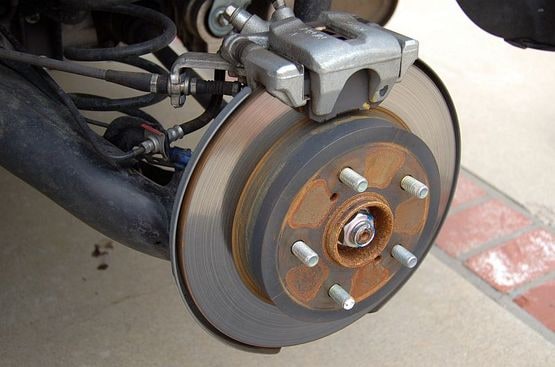
Here we can see that the SX4 uses single-piston sliding rear brake calipers and solid rear rotors.
A word about that rust on the hub: Our SX4 had the most buildup of any of the 17 or so cars I've given the walkaround treatment, by far. I had to use force to get the wheels off after I removed the lug nuts, and I had to use emery paper to remove the rust so I could get them back on and properly torqued. And just like the others in this series, this is a California car.

The parking brake is cable-operated, so changing the rear pads will require the removal of both slider bolts; the stiff cable prevents the caliper from being hinged up when just one is removed.

Our SX4 came with Bridgestone Turanza EL400 (02) tires, size P205/60R16. The rims are 16 x 6 inches.
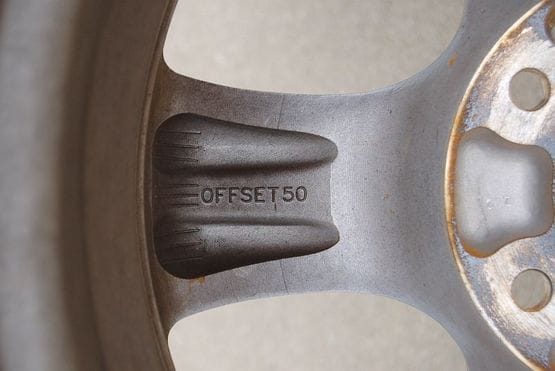
The offset of any wheel can usually be determined be looking at the inside of one of the wheel spokes and reading a sequence of numbers. Suzuki removes all doubt by spelling it out clearly.

By now it's pretty clear that we're taken with our Suzuki SX4. It's got some issues ( range, airbag light, slower than evolution), but it's got a lot to like (I'm not mentioning those, except for the one item that's the subject of this blog, we'll get there, don't worry) too.
One of my favorite things is the Garmin built-in-but-take-outable navigation system. I dig Garmin. I like the interface, I like the graphics and I like that, unlike a lot of factory systems, it's got EVERYTHING IN THE WORLD on it. In our SX4 this little gem sits smack-dab in the center of the dash in a (kinda flimsy if we're being honest) pop-up contraption wired to the factory speakers. I suppose it's nice that voice commands come through the stereo, but I don't use voice commands so mostly I find this feature irritating — it won't let you program things while moving lest you take it out of the cradle. But, when it's plugged into the cradle it, via SD Card, is one of two ways to play MP3s in the SX4 — the first way is via MP3 encoded data CD...but who does that?
How's it work? Click, man!....click!.
Short answer: Not well. Better than nothing.
Long answer: It goes like this...
The whole shebang starts with an SD card and a dream. And by dream, I mean some way of getting data onto an SD card. In my case, it was using the cord that came with my Panasonic Lumix DMC-FX500 and my Panasonic Lumix DMC-FX500. That's why there are no pictures of this step. I dragged a couple of folders onto the portable drive-nee-camera and then went down to the Suzuki to get my music on.
I plugged in the card and....nothing. It couldn't find the device. Great. Back upstairs I realize that all of my music is imported from iTunes and are .m4a not .mp3. If I had a nickel for every time that happened.
So then I refilled my camera-drive with .mp3s and went back to do this the right way.
In retrospect I should have just given up and brought a CD.
Right, so back to business.
First step is to click the "Tools" button at the bottom of the home screen.
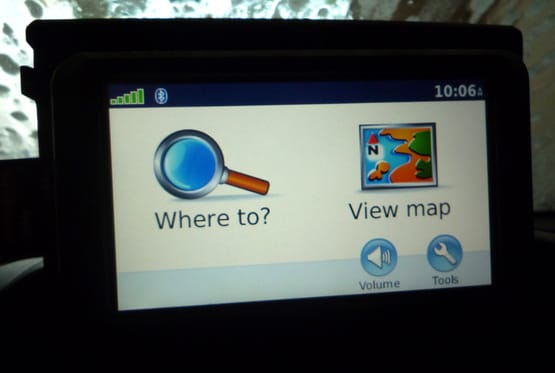
Next, tap "Media Player"

And then "Browse"

All normal enough from this point, we'll continue by clicking "Album" because that's how I roll.

Now, pick an album. I went with Against Me!'s New Wave. Instead of Cake's excellent Prolonging the Magic.
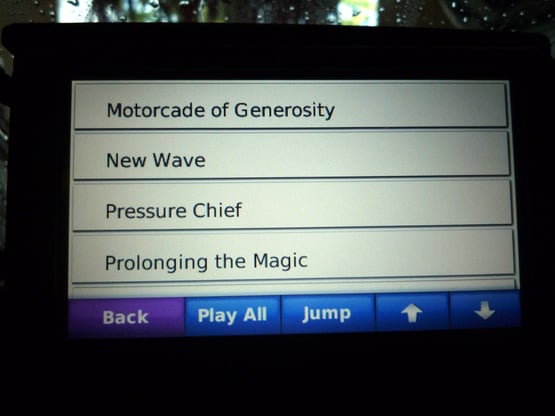
Now this is where things get tricky. The instant response here is to press the first song (or just skip to Up the Cuts because it's better). Don't do that. (Will explain later.) Press the button at the bottom that says "Play all" and the album will play as intended.
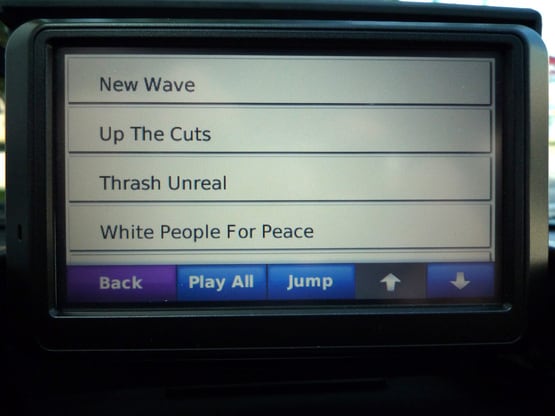
Right. So you're listening and you decide at some point that you did, in fact, want to listen to Cake. The thought here would be to what...hit "back"? (See illustration III for what the screen looks like while music is playing) Or would you touch "browse" It doesn't matter! Because so long as you're rolling, you can't do any of the above, or go back to albums or artists!
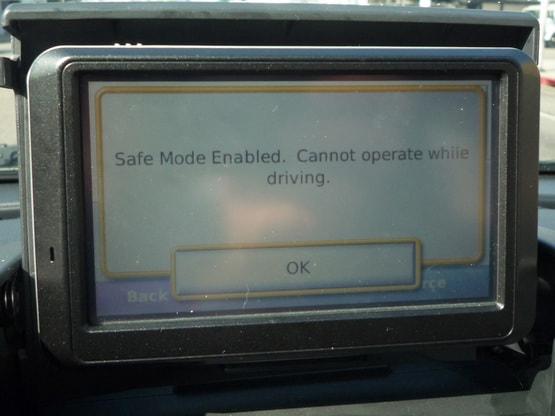
Now let's remember earlier when I said don't touch the song you want to listen to, if you did, right now you'd be driving down the road listening to one song and one song only. There is a way around this and that is, as was mentioned before, to simply take the unit out of the cradle, program what you want and plug it back in. It's possible, but it's irritating. Also irritating: If you have a memory card in the nav and switch to the CD player (You have to pause the nav screen first), it will, randomly, switch back to the mp3s in the Garmin. So that's fun, too.
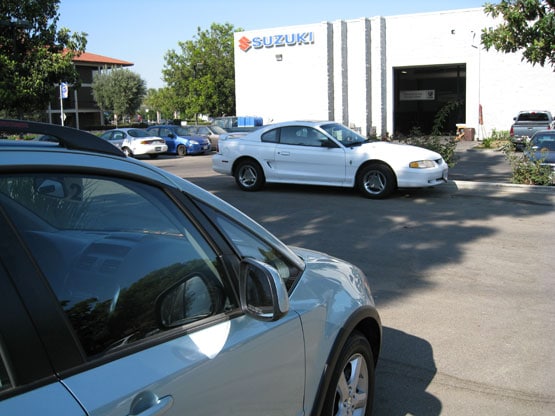
Finally. The airbag warning light in our 2009 Suzuki SX4 is off. This time we hope it's for good.
If you recall the airbag light came on before. And one visit after the next to our local dealer failed to deliver a permanent solution. Annoyed and eager to have the issue resolved we contacted Suzuki directly.
A quick scan of the error code (B1318) confirmed the problem. The right-front seat cushion needed a software update. There was no need to replace any parts. Once the reflash was complete the light extinguished and we were back on the road. Just like that. Too bad we couldn't find a dealer to do this months ago.

One of the subtle pleasures of driving an economy car is their lack of complexity. Look at the dash on our SX4. There's virtually nothing on it that needs explanation. Three dials for the climate control system, a few basic knobs and buttons for the radio and a simplified navigation system that folds out of the way when it's not needed.
It got me thinking, if OEMs offered a simplified dash setup as an option, how many people would order it? Would the average buyer forego all the latest gadgets in favor of fewer functions that are useful more often?
My guess is "no", that's why all those gadgets are there in the first place. Manufacturers would probably love to put dashboards like this in their $50,000 sedans, but customers would surely cry foul. They want stuff for all that money even if they don't use any of it. Might be nice to have the option though.
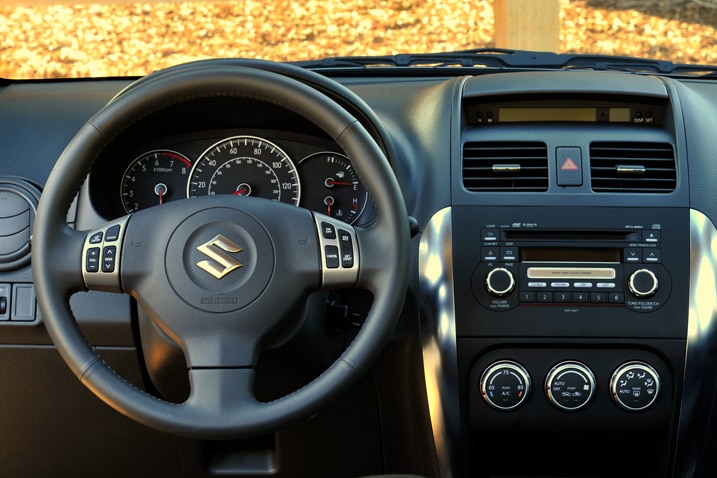
With the stereo off, the steering in our long-term Suzuki SX4 emits a noticeable robotic sound. I can best describe it as the electric motor sound that Robocop (or C3PO) makes whenever they move. It's a high-pitched whine that made me think that perhaps it has something to do with some sort of electric power steering unit - but our SX4 has a hydraulic assist. The sound itself isn't annoying, and with the radio on, you'd struggle to hear it at all. It's just weird.
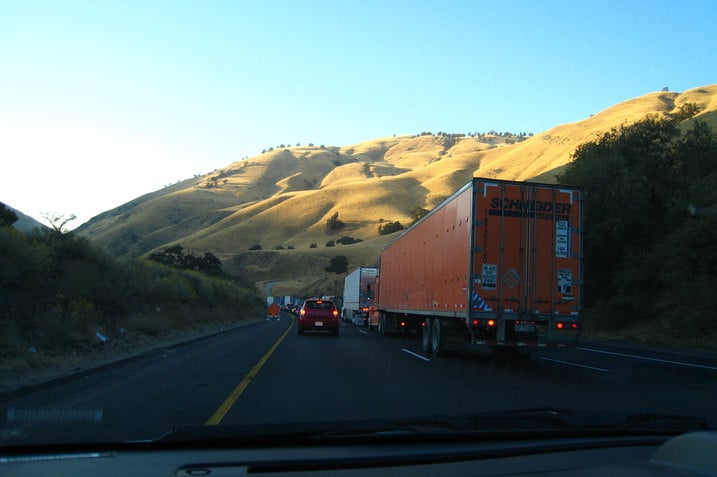
We've never taken a big road trip in our long-term 2009 Suzuki SX4, but that's changing this week, as the SX4 is in the middle of a 2,000-mile LA-Portland-LA journey. The trip had a familiar beginning, as I left Los Angeles just in time to hit traffic, found some open road on the Interstate 5 Grapevine, and then hit another 45-minute delay on the Tejon Pass (two northbound lanes shut down for resurfacing).
I tell you this because the traffic delays added at least 2 hours to my travel time. I logged 7 hours in the driver seat on the first day, followed by 9 hours on Tuesday, and the big surprise? Said driver seat is extremely well-shaped, comfortable and supportive. No kinks or aches in my back or glutes — and this despite the lack of a telescoping steering wheel. Purely from the standpoint of road-tripping, this driver seat is as good as any I've ever experienced among cars in any price range.
But there's another aspect of road-tripping with the all-wheel-drive Suzuki SX4 hatch that isn't so surprising.
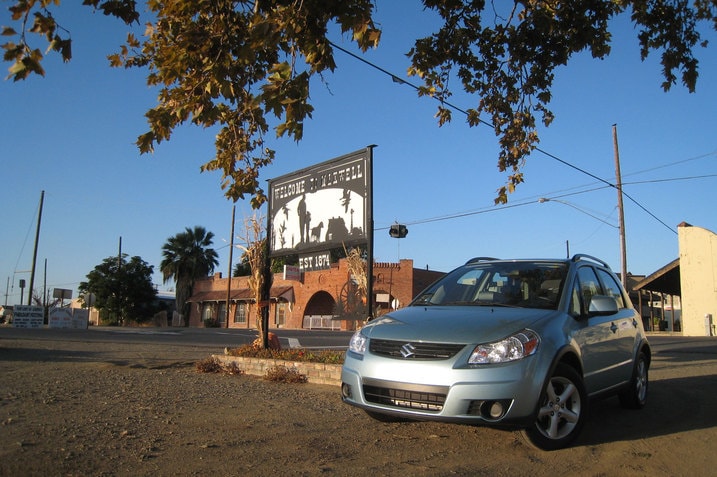
The car's short fuel range, with its 11.9-gallon tank and mediocre mileage (an observed MPG report is coming), is barely tolerable. On the upside, it's a good opportunity to get to know California towns that are off the beaten path. For instance, I got to stop in Maxwell, founded in 1874, because I couldn't make it to Redding. On Monday evening, though, the SX4's limited range forced a stop at a fairly unsavory Shell station.
An obvious solution would be to get the front-drive hatch, which has a 13.2-gallon tank, but then you'd lose the bargain all-wheel-drive proposition. In a perfect world, I'd take a better, more efficient engine, and obviously, there's a new 150-hp motor for 2010.


When the 2009 Suzuki SX4 hit the 15,000-mile mark, we were climbing Interstate 5 through the Mt Shasta area. The first glimpse of Shasta always delights me, but the last time I came through here, I was in a 2006 BMW 330i, which undoubtedly added to the fun. And as we're all aware, this 2009 SX4 is down in the power department (143 hp at 5,800 rpm, 136 lb-ft of torque at 3,500 rpm), and its four-speed automatic is down a couple forward gears.
I'm pleased to report, though, that the climb was very manageable. Suzuki provides manual access to all gears, and the transmission holds gears when it needs to. Killing the overdrive was enough on most grades, but when stepping out to pass particularly slow trucks, I would sometimes put it in second gear (which is fairly tall).
No question, though, there's a lot of engine noise when you're working the car like this, and the whole experience is a lesson in momentum. There's no relaxing here; you've got to carry plenty of speed with you and you've got to keep the throttle pretty close to wide open at all times. It certainly helps that the SX4 steers and grips as well as it does, because you can start your passes on the curves when 18-wheelers and Durangos are at their slowest.
I also didn't hesitate to take the SX4 on Everett Memorial Highway (the road up to the Mt Shasta trailhead), which has a few twists and some elevation gain. I wasn't setting any records with my pace, but thanks to the momentum game, I certainly wasn't holding anybody up.
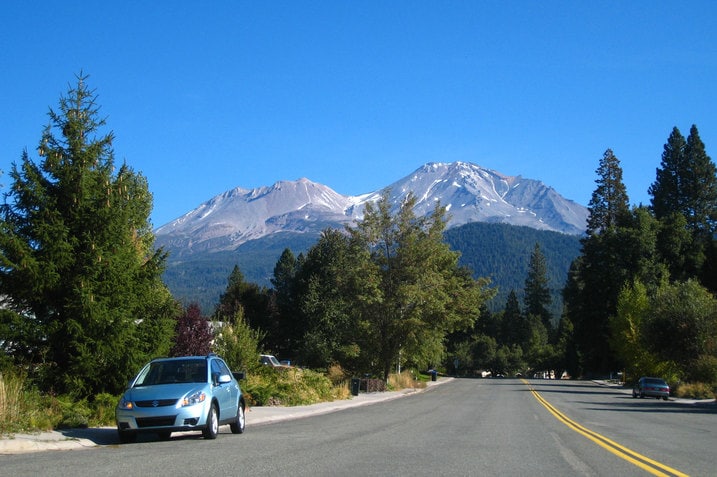
Naturally, all this hard play isn't good for mileage, but it's balanced by some long descents as you approach the Oregon border, so I wasn't gassing up any sooner.
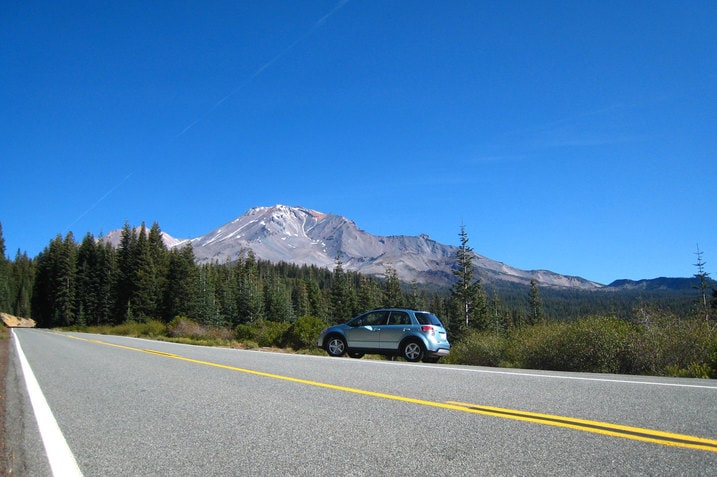

I realized today that titling this series of blog entries about our long-term 2009 Suzuki SX4 hatchback "Oregon Road Trip" is misleading. This is literally the only photo I have of the car in Oregon. The rest of the time it was locked up in a downtown Portland valet while I was busy driving other cars. The SX4 and I spent Wednesday night in Grants Pass, OR, but it didn't occur to me to take a picture of the car in the Holiday Inn Express parking lot. Sorry.
This is not to suggest that it wasn't a long trip. It lasted about 2,200 miles, and I'll have final totals with best, worst and average mpg on Monday morning. Yesterday was the longest single day with 850 miles of driving on Interstate 5, U.S. 199, U.S. 101, CA Hwy 299 and then Interstate 5 again. I'd never used 199 to cross into California from Oregon, and it's pretty lovely, though you'll see just as many redwoods if you use 101.
Before hitting the road yesterday morning, I wrote that performance is adequate with the car's 2.0-liter inline-4 and 4-speed automatic, and I stand by that today. However, I will say that after dealing with the numerous elevation changes along this route (varies between 1,000 and 5,000 feet), the continual planning and determination required to stay up to speed and complete passing maneuvers did get tiring. And a couple times I got stuck behind a V8-equipped truck or SUV on twisty sections only to have the other driver put his foot into the throttle when a passing zone appeared. Thanks.
Fortunately, the SX4's handling and ride quality make up for many an accelerative inconvenience.

I like the way this car's suspension is tuned. It doesn't feel like an aggressive setup, but the SX4 really feels planted through corners — you can't take the initial body roll too seriously; it's a bluff.
Yet, there's a lot more compliance here than you get with a Honda Fit. The suspension does an excellent job of mopping up most impacts before they get to you, and that makes a big difference during an all-day, half-the-night drive — the SX4 feels more comfortable, more substantial (and indeed it is heavier, too, of course) and, in this regard, more refined. There's also less road noise than I'd expect in this price range.
Here are a few more photos — the first couple are from the 199; the last one is just off the 101 in Del Norte County, California... I don't think I've ever driven through here on a sunny day.
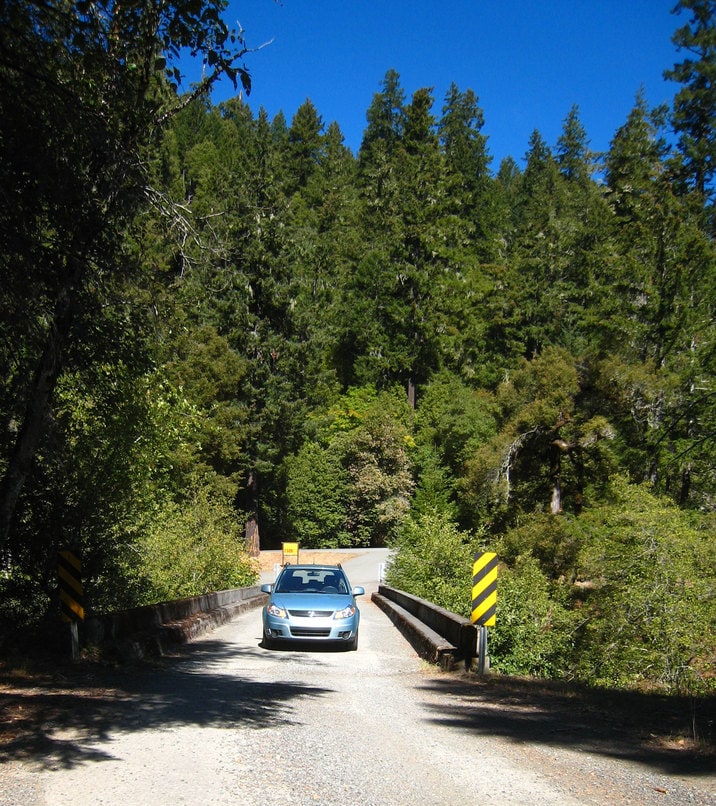

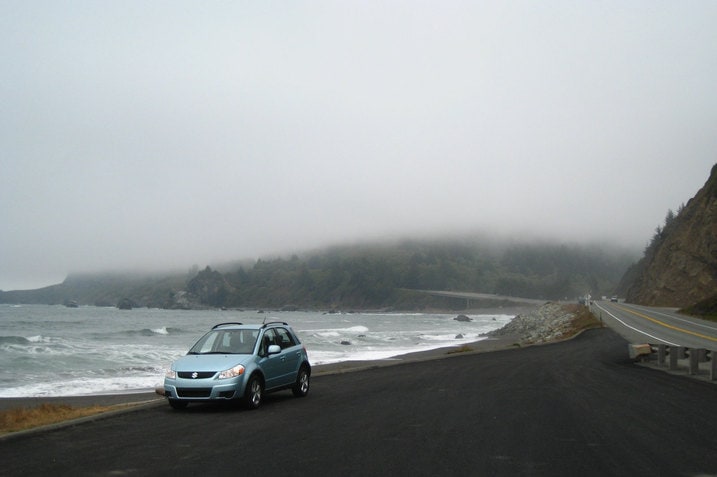

My LA-to-Portland-LA road trip in our long-term 2009 Suzuk SX4 hatchback spanned 2,125 miles. I put in 84.891 gallons of 87 octane fuel.
My best tank was 26.9 mpg over 249.9 miles; my worst tank came during the Mt Shasta climb — 20.4 mpg over 171.7 miles.
My average mpg over the whole trip was 25.0 mpg. That's obviously not very good if you consider the SX4 a rival to the Honda Fit, but for a modestly-powered, all-wheel-drive car driven on a route with plenty of elevation changes, it's not bad. That said, I would have done just as well with the mpg in a roomier, better-performing Subaru Impreza, which also isn't that much more expensive.
Our SX4's lifetime average is now 23.2 mpg. More numbers and opinionated comments after the jump. Bonus point for anyone who knows the location of the Stardust Motel.
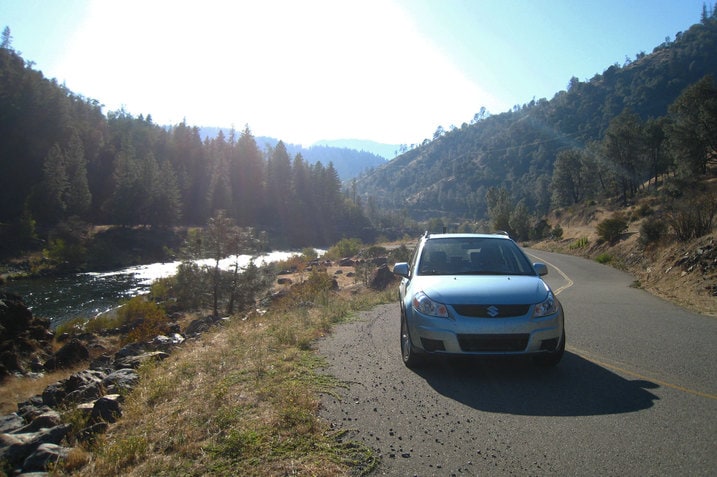
The most fuel I put into the SX4 in a single fueling was 10.497 gallons — not good enough to break our 10.636-gallon record (this SX4 has a 11.9-gallon tank, according to Suzuki's own specs). I did, however, drive 272.0 miles before this particular fillup, and that's the most range we've ever gotten out of this car. Our previous "best" was 256.8.
Evidently, I could have driven even a bit farther before refueling, but at the time, I was really starting to get concerned about whether I'd make it to the next gas station. The built-in Garmin Nuvi kept me going here: Although most functionality is disabled when the car is in motion, it does at least allow full POI searches and destination selection (Nissan/Infiniti factory nav systems, for example, only allow a limited POI search). So I identified a 76 station in McKinleyville, CA and kept my sights on that.
Other thoughts from the trip:
-->Brake pedal feel is very good in this car.
-->Wind noise is on the high side due to the huge glass area.
-->The driving position is quite comfortable and natural-feeling in spite of the tall, captain's-style chairs and lack of steering-wheel telescope adjustment.
-->Our 2009 SX4's sunvisors lack extenders, thus leaving you exposed to the afternoon sun when driving north on Interstate 5; however, 2010 Suzuki SX4s get sunvisor extenders — nice.


After returning from my 2,100-mile road trip in our long-term 2009 Suzuki SX4, I checked the tires and the oil. I added 1-2 psi of air to each tire. The oil level registered just under the halfway mark on the dipstick, so I added a smidge of 5W30. As one would expect on this class of car, the owner's manual is lenient on the type of oil you may use, suggesting only that it should be a bottle of 5W30 with the American Petroleum Institute seal.
The dipstick is conveniently located (red arrow), as is the filler cap (yellow arrow). However, the mouth is recessed a few inches, so a funnel would really be helpful. I'd left mine at work, though, so I had to dab up some spillage.

On an unrelated topic, I've forgotten to mention how good the low-beam headlights are on this car. Some time ago, a friend pointed out how large the headlights' reflector boxes are — which should translate to a good spread of light on dark roads. Turns out he was right. I did a lot of night driving on my Oregon road trip, and the low beams did a great job of illuminating the road — I only used the high beams on a couple occasions.
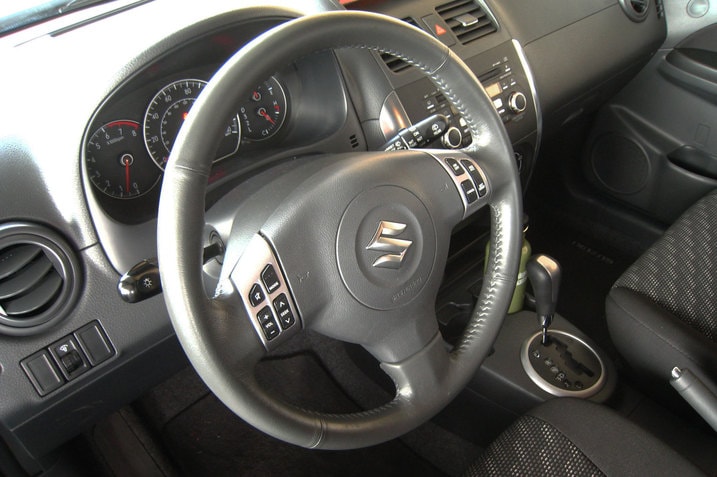
Our long-term 2009 Suzuki SX4 hatchback deserves credit for its steering wheel design. Not only is this an attractive, three-spoke wheel, it's comfortable to grip at 9-and-3. This is due both to its leathery wrap and the stitching used to join the sections of leather (or leather-like material).

Too often, cars in this price range have rough stitching that scratches against my thumbs. But both the thread and the method of the stitchwork in the SX4 have resulted in a seam that feels smooth to the touch.
It's a small thing, I know, but it really made the SX4 more pleasant to drive during my recent 2,000-mile road trip.

This weekend I was trying to find a theatre on the UCLA campus in Westwood. I knew how to get there in general but I needed help finding the exact location once I got close. I didn't really need the navigation but I wanted the map open.
The Suzuki SX4 has a funny little nav. I often forget it's there because it pops out of the top of the dash.
With such a tiny screen, it takes some getting used to. If you zoom in close enough to see street names, you lose the frame of reference around you because you see such a small area of the map.
It has some really helpful features, however. Across the top is a green bar that lets you know what street is coming up. It posts every little side street, even if it is not a turn-off. I found this most useful when driving around Westwood. I knew if I hit Sunset Boulevard I went too far. As I was looking for the theatre's parking structure, I could see Sunset just ahead. But then the nav pointed out a little driveway on the left, which was the street name I was looking for. It saved me a lot of time.
In the picture above, you can see in the middle left of the frame, the nav tells you the speed limit of the street you are on. And just below, it tells you the speed you are traveling. Nice touch. In Southern california speed limits can change in the middle of a block with no warning, depending on what town you are in. Cross an invisible border and suddenly you're speeding.
Another cute feature: Your position is marked on the screen by a little car icon. I wonder if this image is always blue or if it is blue on our screen because our SX4 is blue. Any SX4 drivers out there know the answer?
Turn Up Your Volume
As Mark mentioned in an early post, our Suzuki SX4's steering wheel makes a weird robotic sounds when turned.
Here's a video of the steering wheel. It's hard to capture sound on my Flip. Turn up the volume to hear it.

Thanks to its low beltline, big greenhouse and useful little port-type windows by the A-pillar, the SX4 offers pretty good visibility. That might be enough for most manufacturers, but Suzuki takes things one step further by including the hugest side mirrors this side of a Dodge Sprinter. These massive slabs of glass are the antithesis of the skinny little side mirrors seen on cars like the new Camaro — form-over-function mirrors that look stylish, but don't offer much acreage for viewing purposes. Sure, the SX4's mirrors are a bit on the homely side — they're the side-mirror equivalent of dad jeans in that respect — but they're a pleasure to use, and offer a wonderfully expansive picture of the road behind you.
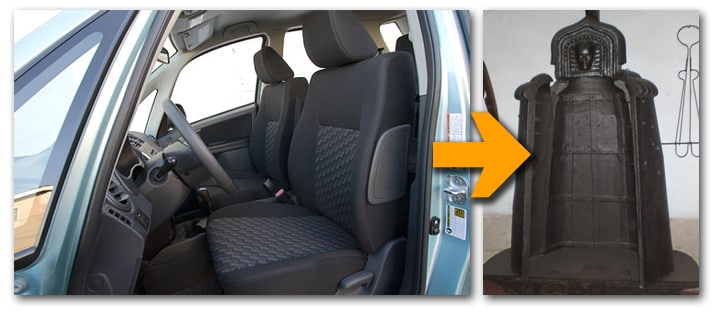
I'm going to have to disagree with Erin's assessment of our SX4's seating. After spending about four hours in the blue box yesterday, I realized that average-sized American males may have issues with the driving position.
I'm 5'10" and of average build, and I could not find a comfortable seating position. The lack of a telescoping wheel was probably the main culprit. With the seat adjusted for leg comfort, the wheel was way too far away from me. With the seat adjusted to have the wheel within comfortable reach had my legs bunched up. I tried a compromise between the two and everything started aching after 45 minutes.
Then there's the elbows. The door armrest is made from an unyielding piece of plastic. Remind me to pick up some elbow pads from the sporting goods store next time. The center armrest is at least cloth covered, but the angle is all wrong and is uneven with the other side's medieval perch. There's also a hard lump under the corner stitching that hits right where my forearm should rest.
None of this bothered me before on shorter trips, but this was the first (and hopefully last) long trip I took in the SX4. For the rest of the day, I'll be popping Advil like PEZ.
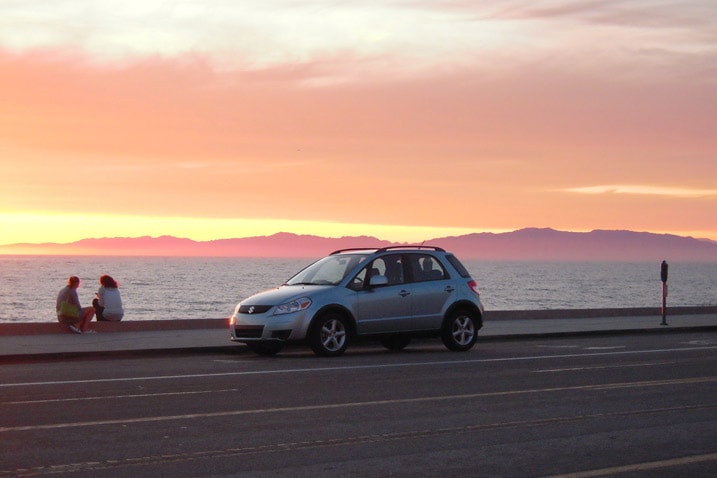
Driving around in the Suzuki SX4 this weekend, I noticed the car gets a lot of looks.
I spotted people sneaking peeks in their mirrors or turning heads while walking down the street.
At first I thought it was my new haircut (just kidding, of course) or that they were giving me the stink eye for some reason.
But then I realized, the Suzuki is a good-looking vehicle, especially in its light blue paint.
Passersby were just appreciating its handsomeness in the golden sunlight.
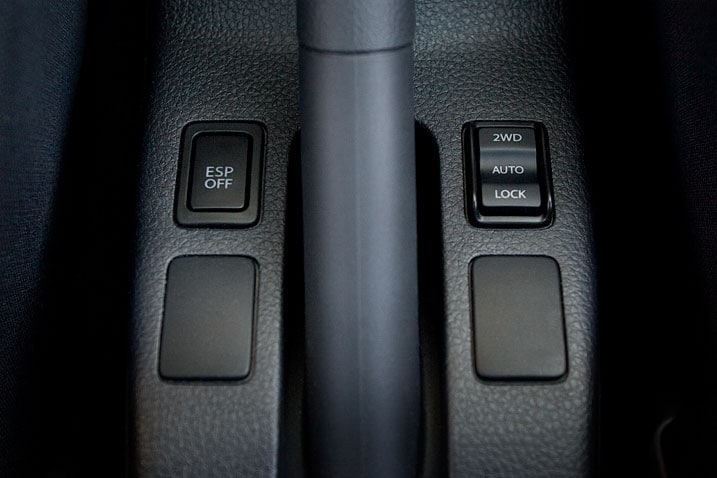
(Photo by Kurt Niebuhr)
Like everyone else here, I'm not thrilled with the pathetic range of our 2009 Suzuki SX-4. It's mostly due to the small gas tank made necessary by the all-wheel-drive system, and could be fixed, for us here in Southern California, by deleting that option. But this Suzuki has a neat little trick up its sleeve that, in a sense, increases the range on the AWD SX-4.
See, what they've done is equipped the SX-4 with an "electronically controlled coupling device mounted in front of the rear differential." There's a switch (pictured) to pick between all and front wheel drive. Power/Fuel economy losses are estimated at 5-10% for all wheel drive vehicles and having the option to use it only when needed — ie: not in your daily commute to work — is a plus.
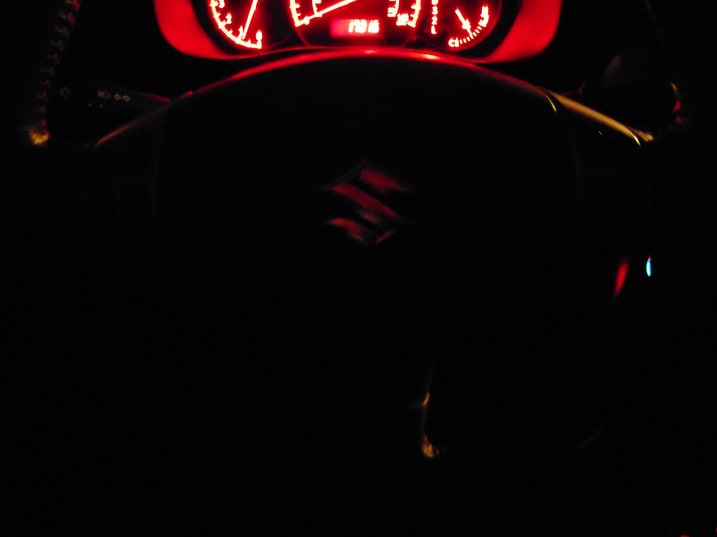
There are helpful buttons on the steering wheel of the SX4 for the audio and cruise controls.
However, they are not illuminated. So, I can't see them at night.
When I'm listening to the classic rock station (the only tolerable station we have left in L.A. since the Indie station went online only) and a Styx song comes on, I have to reach over to the actual radio to save my ears.
Sorry, Styx. But I had an old boyfriend who tortured me with your music too often in my youth. Bad memories.
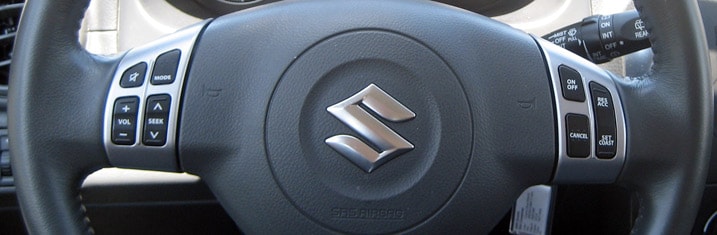
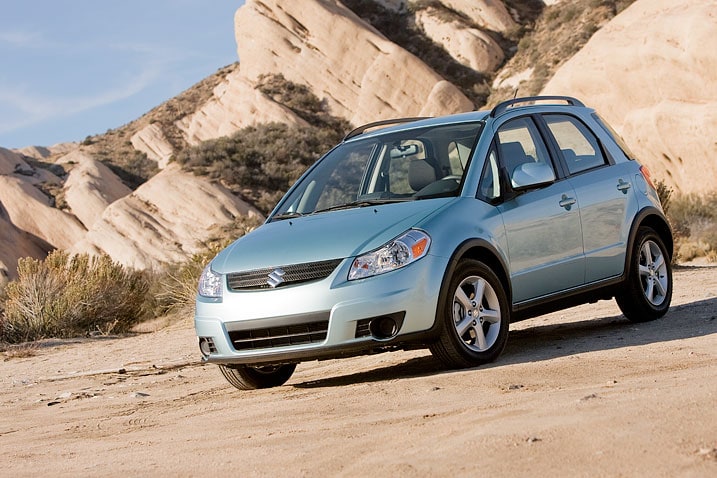
Photo by Kurt Niebuhr
This weekend, as we were getting into the SX4 for a marathon session of errands and family duty, my husband said, "Wow, I forgot how much visibility this car has." He was really impressed with how much he could see while in the front seat of Suzuki's little hatchback. I thoroughly agree. With a lot of other modern cars, I feel like I'm fighting with the car to see clearly in all directions. Not so with the SX4.
While reversing into a parallel parking spot, I was immensely grateful to be able to see where the car ended just by looking over my shoulder. Not a surprising trait in a small economy car, but a welcome one nonetheless.
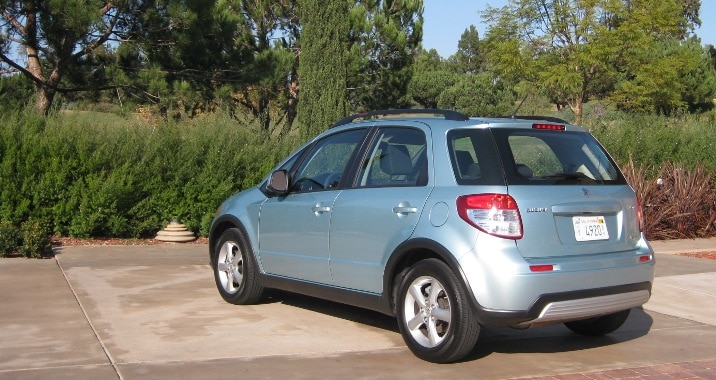
I had a quick biz trip down near San Diego this week. Del Mar, to be precise, which is about 115 miles from our office in Santa Monica. After considering my trio of vehicle options (Ram pickup, Challenger, SX4), I went with the Suzuki. And there were a trio of reasons for my choice: fuel economy, a nav system and Bluetooth. Follow the jump to see how it fared...
Fuel economy: B-
For the 230-mile round trip (virtually all highway, and apart from a few miles of slow-moving traffic, moving along nicely at 70-75 mph), the SX4 averaged 26 mpg against the EPA highway estimate of 28 mpg.
Note: The 2010 SX4 AWD automatic will be a CVT, and mileage estimates improve to 23 city, 29 highway and 25 combined, versus our '09 with a 4-speed automatic's 21/28/24.
Navigation System: B
A bit of a reach to access, so if I had an address to enter I would detach it (it's removable from the car) and type away, obviously when I was sitting parked. And thanks to its simple, intuitive layout, entering addresses and finding gas stations and yes, Starbucks, were quick work. The voice prompts, however, sound like they're from a 1980's voice synthesizer. The Suzuki's Max Headroom is certainly not as smoothly spoken as the lady in our Honda Fit's nav system. Then again, the SX4's system came standard as opposed to commanding a near-$2,000 premium as with the Fit.
Bluetooth: C
It's nice that the system automatically downloads your phone numbers (no, they don't all do that). However, the transmission quality was sometimes rather poor. At times, the person on the other end couldn't hear me that clearly, prompting one to say that it sounded like I was underwater. Or that I was Charlie Brown's teacher.
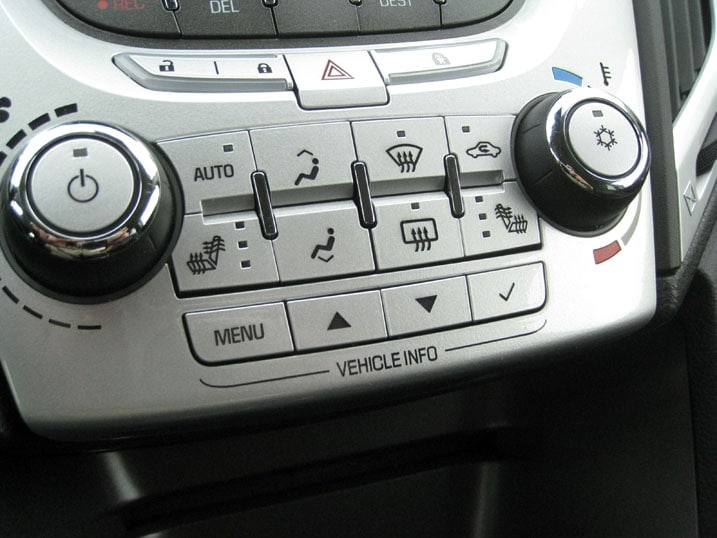
Here's something I like about our SX4: Suzuki hasn't tried to reinvent the wheel with its center stack secondary controls. Both the audio system and the ventilation controls follow accepted industry norms and are efficient and simple to use. The volume knob is on the left and the the tuning knob is on the right. Ventilation adjustments are made simply enough through three knobs and three buttons. Simple and good.
There's room for improvement in this design, but at this price point most manufacturers make it more difficult to use when they change the design. Thanks, Suzuki.
I appreciate cars that have a "dead pedal", that cryptically-named foot rest located on the far left side of the driver's footwell. To clarify, not all cars have a dead pedal. In fact, it used to be only high-performance cars had one so your left foot/leg wouldn't slip while you ripped through some tight corners.
The SX4 has a dead pedal — nothing fancy, just a piece of semi-grippy black plastic that does the job of keeping one's left foot from sliding. But as it turns out, this dead pedal is alive. Press down on it a little and it flexes and squeaks as if it's one of those old-school, floor-mounted headlight high/low-beam switches. A minor build-quality issue, evidently as there's space underneath the SX4's dead pedal that allows the flexing, as opposed to it being affixed solidly to the floor pan.
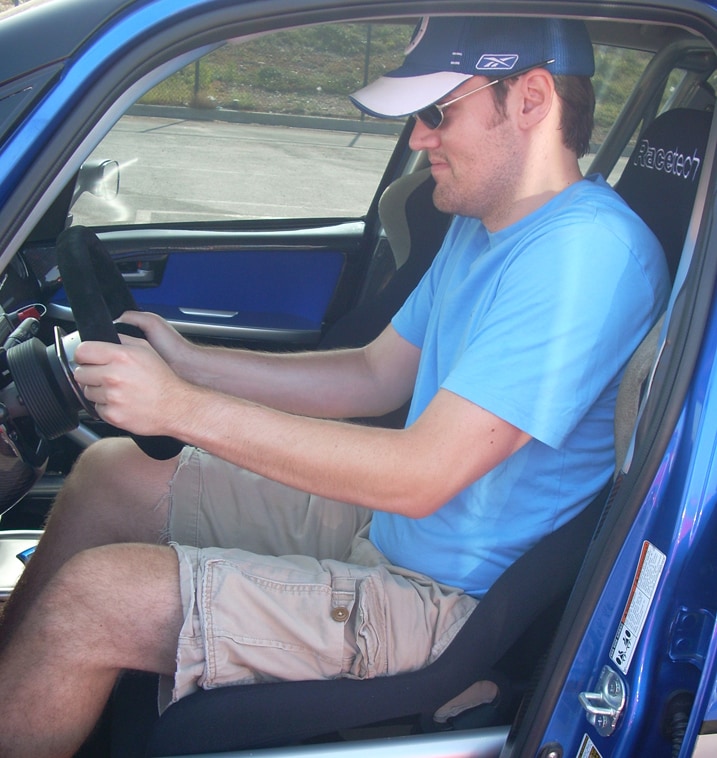
OK, so that isn't our SX4. It's the crazy SX4 Zuk race car thing dropped on us a few months back that had a racing seat sized for .86 Riswick. I was a good 2.5 inches from the seat bottom, stuck on the side bolsters. Magrath said, "hey, go grab the SX4." I laughed and answered, "um, unable to comply."
Any way, I don't fit in the regular SX4 either. There is no driver seat adjustment and the set position is too high in the back (photo after the jump). I feel like I'm hovering above the controls and I'm needlessly close to the roof despite the greenhouse being the size of Biodome. It makes an otherwise pleasant car to drive completely miserable. But I suppose it could be worse ^^^.
P.S. You happy dougtheeng?

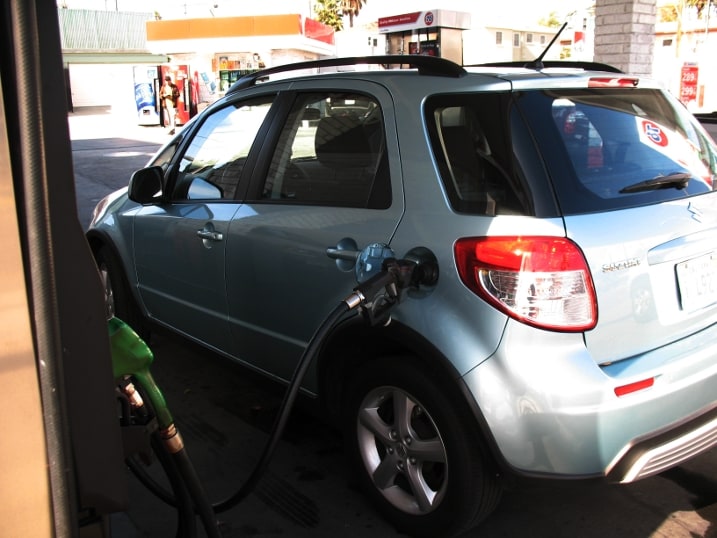
I'm a big fan of the SX4. I dig its roomy cabin, standard nav system and relatively smooth ride quality; still, it doesn't exactly sprint with the lightning speed of Usain Bolt. With this sort of tepid acceleration, the payoff is usually stellar fuel economy. But the SX4 ain't no champ in this area either, bringing up the rear in its category.
I thought about all this as I was making a recommendation this weekend to a friend who's in the market for a new car in the sub-$20,000 price range. My buddy's goal? He wants a cheap ride that's decent to drive and easy on the wallet at the pump. I love you, Suzy, but in this case, the smart money's on the Fit.
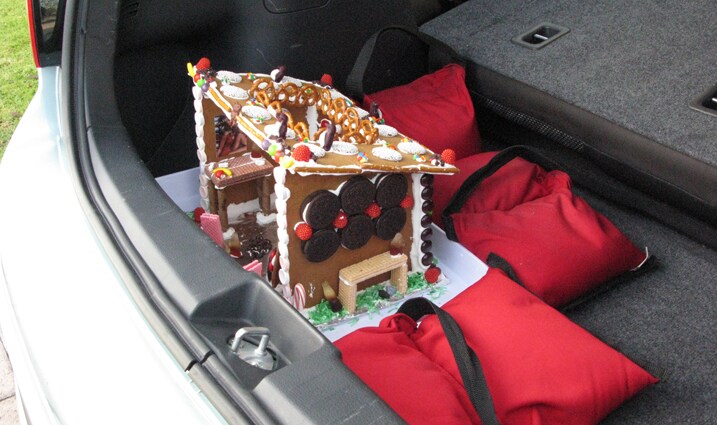
That's a gingerbread garage in the cargo area of our LT Suzuki SX4. I made it for our staff's holiday sweets extravaganza and needed to transport it to the office this morning. Last night, as I was plastering the tiny Farrah Fawcett poster to the interior wall with royal icing, it occurred to me that all the doodads I had painstakingly stuck on the thing might fall off during the ride to work. Or worse, it might just collapse alltogether (in which case, the plan would be to claim that it was a post-earthquake gingerbread garage.)
Would the SX4's ride be too bumpy? Should I have requested the 7 Series instead? Should I wrap the thing with blankets, strap it in with a seat belt, set it on a pile of mini marshmallows, walk the 7 miles to work holding the tray in my outstretched arms?

I decided to tuck it into the corner of the cargo area and use three of my husband's sandbags (photo gear for his business) to keep the tray from sliding around back there. And then drive like a grandma. And it worked! Nothing fell off or broke. The only thing I'd do differently is secure the cardboard (that I mounted the garage onto) to the tray. Because I neglected to do that, the garage and its attached cardboard did slide back and forth on the tray a bit.
My paranoia also caused me to pay close attention to the ride quality of the SX4 and I have to say, it wasn't bad. I tried to avoid holes in the road and uneven pavement whenever I could, but what overall it was pretty smooth.
Happy Holidays!
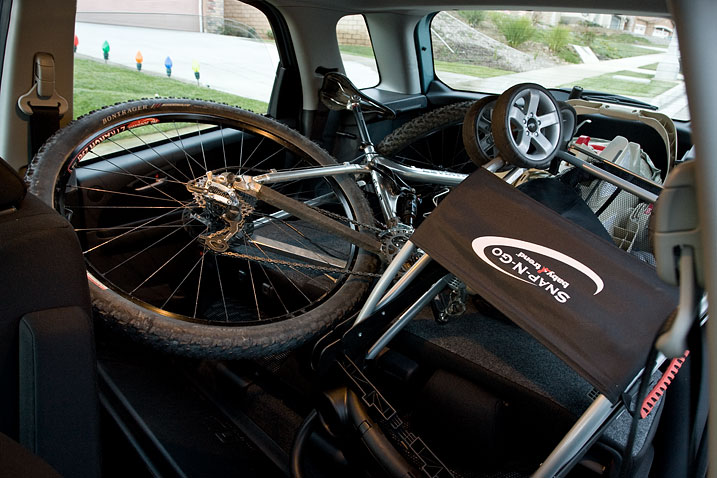
Go ahead. Tell me what's going on in the back the SX4 in this photo. Because I'm yet to figure it out.

"Wait, was I driving with the emergency brake on this whole time?" I chastised myself when I was on the freeway and noticed the "Brake (!)" warning light on the dash. I hadn't noticed the car driving differently from the time I left the Edmunds garage and jumped on the 10 East. And when I went to check the e-brake, it was down as far as it could go. But then the warning light switched off when I pressed the e-brake button.
Later when parked, I pulled up the e-brake to see where its last detent before off was and it was at about a 15-degree angle from off, so it would have been pretty obvious that it was still on. Well that's a relief anyway. That I didn't drive with the emergency brake on.
However, throughout the weekend that brake warning light kept popping on and off, leaving me to wonder if this was my car would I be motivated enough to get this fixed or would I just learn to live with it. It's not like it affects the driving.
It reminded me of how my brother drove around with the "Check Engine" light of his Nissan Sentra on the entire time he owned it. He got the car checked and the shop canceled that light but then it ended up popping on again anyway and he gave up.
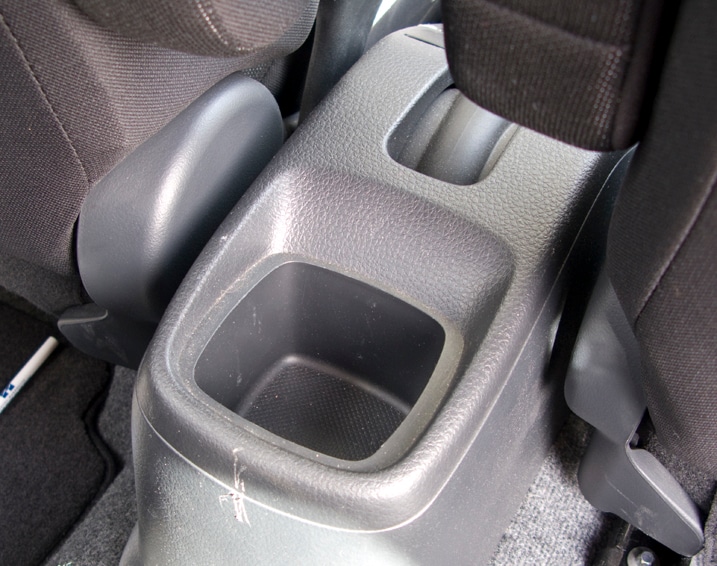
I recently had the need to make use of the rear cupholder in our LT SX4. I was in a hurry to get somewhere with the kid, I had a Sigg water bottle (.6L) to stash and the front two cupholders were already full. "Ah! rear cupholder," I thought. So I tried to cram it into the little center-mounted rear cupholder. No dice; it was too wide (and round) for the squarish cupholder's small space. I tried switching the Sigg bottle with a Solo-style to-go cup that had already been up front (where the Sigg does fit). Nope, that cup didn't fit in the rear cupholder either. Argh. There's also the problem of the front armrests' eating into the vertical space above the rear cupholder. Only the narrowest of tall drink containers will fit between those armrests. Even if the Sigg had been slimmer, it still was too tall for those armrests.

So what does fit in that cupholder?

I have found one thing: a can of soda, which has a 2.5 inch diameter and is a little less than 5 inches tall. A single-use water bottle would probably fit, too, but I didn't have any around to test.
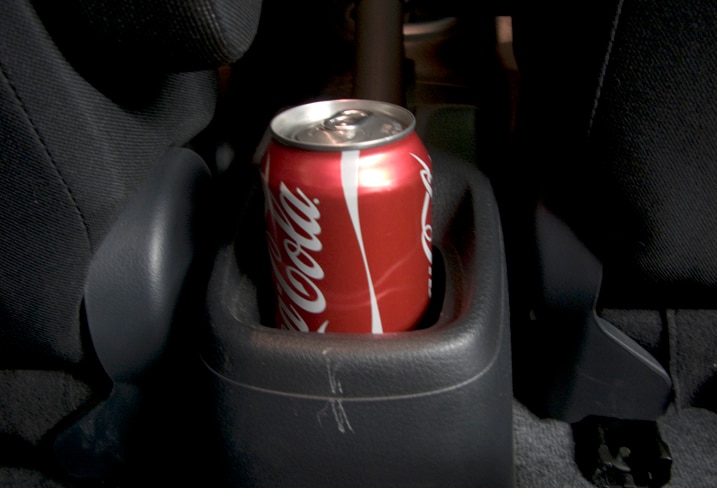
What other types/shapes/sizes of drinks would a person want to put in that cupholder, and do you think they'd fit?

This morning I was minding my own business, just standing there and casually opening the hood of our 2009 Suzuki SX4 in preparation for an oil change. And then I saw what you see above.
What the? How did this happen? I don't think it could have come off on its own. The motor mounts prevent the engine from torqueing over too far. Besides, there has to be some torque. (OK, that was a low blow.)
Could someone have left it off while poking around in there, looking at something? Or maybe they took it off thinking they'd discovered some hot-rod performance trick. Not likely. This set-up ensures that engine breathes nothing but hot underhood air. The pipe brings cooler, denser air from outside.
Luckily, the air filter is integrated into the engine cover to the left so the engine wasn't wheezing on dust and twigs and bugs.
Let's pop that baby back on there.
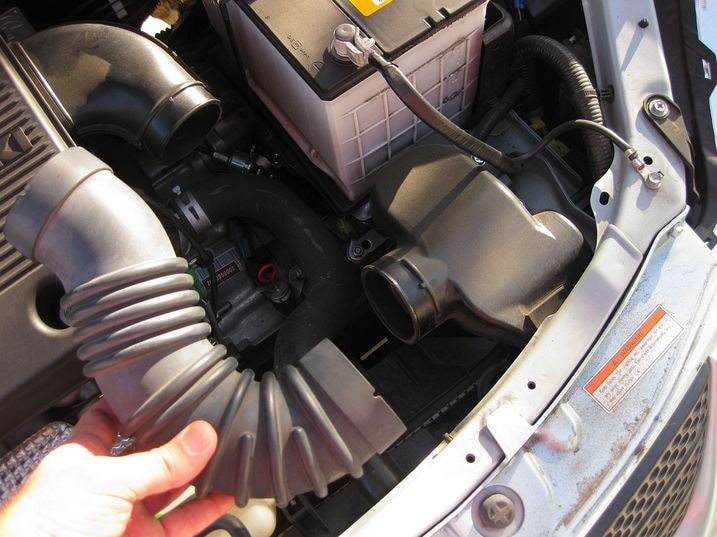
Let's see ... it goes like this.
There, good as new. Maybe this explains why the SX4 felt slower than usual coming home yesterday.


Our 2009 Suzuki SX4 rolled past the 20,000-mile mark on the way home yesterday. I missed the big moment because traffic speed was varying wildly between 35 and 70 mph just as the odometer rolled over. I had to wait.
A few miles further back I had refueled the SX4 with the low fuel light on, the needle buried past "E" and 276.4 miles on the trip odometer. Divide that by the 10.35 gallons I added and you get a respectable 26.7 mpg. Not the best tank we've seen — that was 28.3 mpg — but pretty good for mixed driving.
But a quick check of the Zuk's fuel log shows that the 276.4 miles I got out of this tank represents the longest range we've EVER coaxed out of this car during the entire 20,000 miles we've had it. And I only managed it because I had ignored the low-fuel warning when it came on at 250 miles so I could stop at my favorite station.
Why is the range so lousy when the mpg is this decent? Our AWD SX4 holds just 11.9 gallons of gas. As Brody might have said had he owned this car, "You're gonna need a bigger tank." Or maybe Brody should buy the 2WD version. The lack of a rear driveshaft means it has a 13.2-gallon tank and slightly better mpg. It should get to 300 miles once in awhile. Heck, once would be nice.
But a stick-shift won't help the cause. The Suzuki SX4 is one of an increasing number of cars that gets better mpg with an automatic than it does with a manual.
Call it a case of killing two birds with one stone. Our 2009 Suzuki SX4 was due for an oil change. I have been encouraged to make more use of video in my posts. Why not document the oil change process on video?
Well, I don't have any experience with video editing software and the only software I have is MovieMaker, the Microsoft default that came on my PC. My "video camera" is nothing more than a mode in my small Canon ELPH point-and-shoot still camera.
But, what the heck. I do have a couple of tripods and the weather is good on this dead-of-winter SoCal morning.
So I trotted down to the local auto parts store for 5 quarts of oil and a new filter. Cost me $28.21.
I was going to add narration, but that seemed time-consuming and I decided the background sounds were interesting in their variety and the ELPH's little built-in mic picked them up reasonably well. I do need to figure out how to muffle the wind noise for next time, however.

Just before the holidays our 2009 Suzuki SX4 started to intermittently display brake system warning light. This indicator happens to be red and federal safety regulations reserve this color for Serious Business such a brake system problems or air bag faults, so this is not a "live with it" situation.
The light routinely comes on when the parking brake is engaged as a reminder to release the brake before driving off. I check to see if the switch near the parking brake handle was faulty, but that was a dead end.
Next stop: under the hood for a look at the master cylinder...

The master cylinder has a electronic sensor that monitors brake fluid level. If the fluid level gets too low it will turn on the same dashboard warning light used by the parking brake. If the brake is released and the switch seems predictable, look here.
Two visual references are molded into every master cylinder reservoir. Here the Max level (black) is high and dry and the Min level (yellow, just visible below the joint line) looks marginal. My driveway is far from level and on flat ground the fluid level corresponds to Min line. We have found the reason for the warning lamp.
But I need to look around before I add any brake fluid. There are no obvious leaks, so where could the fluid have gone? Into the brake calipers, of course. As brake pads wear down over time, the pistons protrude further and further out and the caliper bores draw and hold a gradually increasing amount of brake fluid. There is no leak, the brake pads are simply wearing down and the fluid level indicator is serving as an ersatz pad wear indicator.
A quick check of the pads confirms this. The rear pads look quite thick, but the front ones are looking thin. Not thin enough to change, mind you (this is where the ersatz part comes in), but thin enough to make a mental note that a change is due soon. I give them no more than a month.
Instead I added a little brake fluid from my personal stash to shut off the light and keep the level above Min.
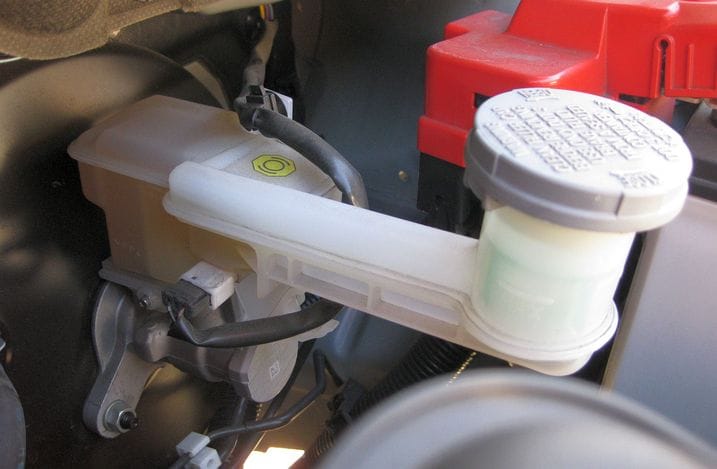
It's clearly above the Min line now and the sensor should be immersed. But it's nowhere near Max. When didn't I fill it all the way? Well, when the pads are eventually changed the pistons will have to be pressed back into the calipers to make room for the new, thicker pads.
The fluid that's displaced during that process has got to go somewhere, and that somewhere is back up into this reservoir. If I fill it to Max now, the master cylinder will overflow and spill out the top when the pads are installed later if I forget to take a turkey baster and suck some out during the process and dispose of it someplace.
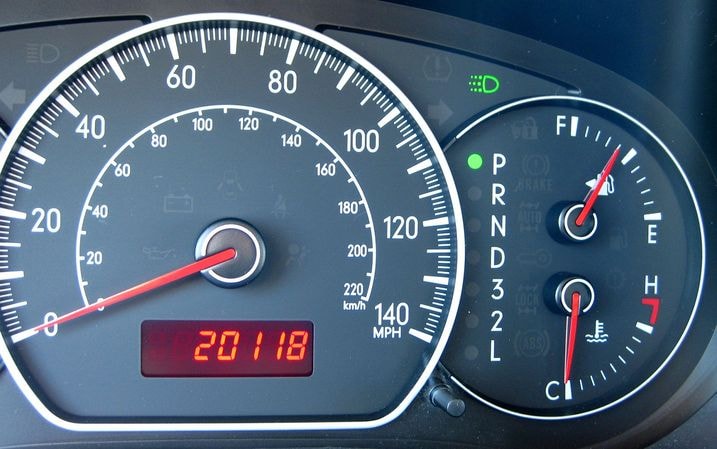
Success! The light is back out, illuminating only when the parking brake is set. Now for the bad news: Our 2009 Suzuki SX4 will be lucky if it sees 23,000 miles before it needs a set of front brake pads. That seems a bit short for a car that isn't particularly speedy and spends little time in the mountains.

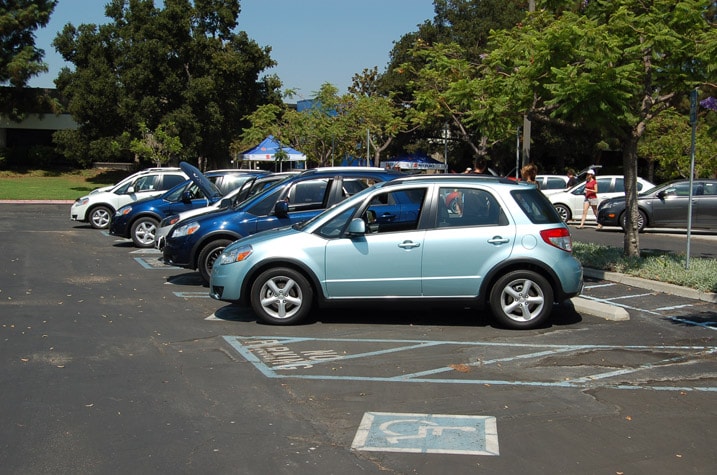
Our 2009 Suzuki SX4 is gone. Read the wrap up and then come back and see our parting shots, and don't forget to add your own!
If the Italians were still doing business in the U.S., the cars would be just like this Suzuki. And I mean that in a good way.
Michael Jordan
Executive Editor, Edmunds.com
----------------------------------------------------------------------------------------------------------------------------------------
"Hey Mike, the SX4 has a check engine warning light on."
--Check the gas cap.
"Hey Mike, the SX4 has a brake warning light on."
--Top off the brake fluid.
"Hey Mike, the SX4 has an airbag warning light on."
--That part is on order.
"Hey Mike, the airbag warning light is on again."
--That part is still on order.
"Hey Mike, the SX4 has a headlight warning light on."
--That's because your headlights are on.
"Hey Mike, with all these warning lights, has the SX4 ever broken down or left anybody stranded?"
--Nope.
Mike Schmidt, Vehicle Testing Manager
----------------------------------------------------------------------------------------------------------------------------------------
Techno toys alone can't make a terrible car great, but they can make an otherwise mediocre car much better. Just knowing the SX4 had navigation and hands-free telephone technology made it easy to grab the keys for a weekend.
Karl Brauer, Editor-in-Chief, Edmunds.com
----------------------------------------------------------------------------------------------------------------------------------------
Am I the only person on staff who liked the Suzuki SX4? It had its issues but I thought it was cute and practical. It had good visibility, a helpful and removable navigation system, clear and easy-to-use climate controls, comfortable cloth seats. It was nice.
Donna DeRosa, Managing Editor
----------------------------------------------------------------------------------------------------------------------------------------
"If there was ever a car that truly needed another 50 horsepower, our SX4 was it."
Kurt Niebuhr, Photo Editor
----------------------------------------------------------------------------------------------------------------------------------------
This was a stout little AWD runabout that seems tailor-made for members of the just-married set who must deal with snow in winter. Well built and functional, the only thing it really lacked was decent power and a full-coverage dealer network. The former has been improved for 2010, but the latter probably limit the SX4's appeal to specific geographic hot-spots.
Dan Edmunds, Director of Vehicle Testing
----------------------------------------------------------------------------------------------------------------------------------------
Voted "Vehicle Interior Most Likely To Retain Fast Food Smell."
Kelly Toepke, News Editor, Edmunds.com
----------------------------------------------------------------------------------------------------------------------------------------
"Likeable but not game-changing. That pretty much sums up my feelings on the SX4. It was better than our long-term Ford Focus but not as likeable as our long-term Honda Fit. A 2010 SX4 with a manual transmission, a different color and SportBack suspension tuning would be noticeably more fun to drive I think."
Brent Romans, Senior Automotive Editor, Edmunds.com
----------------------------------------------------------------------------------------------------------------------------------------
I didn't fit in it. So I didn't drive it.
James Riswick, Automotive Editor, Edmunds.com
Wrap-Up
First times are always special. It's the wave of release after the seemingly endless ascent — longing and looking, reaching and waiting. It defines a truly special time in a young Web site's life, and it's how we felt as we took the keys to our very first long-term Suzuki, a 2009 SX4.
Loaded with all-wheel drive, an automatic transmission and a built-in Garmin navigation system, the 2009 Suzuki SX4 crossover represents a right-car-at-the-right-time proposition for a small carmaker existing on the fringe of a shrinking market. Crossovers have been the height of cool, the Honda Fit has been selling strongly and global warming was sure to kill us all, so we expected the Suzuki SX4 would speak to us about the future of small cars.
But that was a year ago. In that time we rolled the little Suzuki across 20,000 miles of real-life pavement; did the reality of owning a Suzuki meet our expectations?
Why We Got It
While new to our long-term fleet, the SX4 is not exactly a new vehicle. It debuted in 2007 and has been updated with the addition of a front-wheel-drive model and the expansion into a sedan body style. What the 2009 Suzuki SX4 brought to the table was its status as the U.S. vehicle with the least expensive built-in navigation system. Suzuki accomplished this feat by simply teaming up with Garmin to produce a unique adaptation of a portable navigation device for automotive use. It made you wonder why no one else had thought of it before.
Simplicity has always been Suzuki's message, and the time seemed right to gauge the appeal of this way of doing things. Moreover, the SX4's combination of American-style utility and international-style components (engineered in Japan, styled in Italy and manufactured in both Japan and Hungary) also seemed in tune with the spirit of the times. It was the right time to get a Suzuki.
Durability
Three things dominated our long-term experience with this 2009 Suzuki SX4: cruising range, engine power and an airbag warning light. But we'll get to that.
What makes the Suzuki SX4 really stand out is its price with standard navigation, and this feature got our attention from the first. This Garmin unit was almost universally praised by our staff, though Edmunds Automotive Editor John DiPietro wished it was closer to the dash. Vehicle Testing Assistant Mike Magrath said, "One of my favorite things is the built-in-but-take-outable navigation system. I dig Garmin. I like the interface, I like the graphics and I like that, unlike a lot of factory systems, it's got EVERYTHING IN THE WORLD on it." Not only did we appreciate the Garmin unit while it was mounted in the SX4, but it was also handy when Edmunds Automotive Editor James Riswick decided it would look better in his personal Z3.
Other automotive navigation systems can't operate in multiple cars, or while you're walking or hiking. Now if only the SX4 had the cruising range to make it out to some fun trails away from the asphalt. But hold your horses, we're getting there.
There was more to the 2009 Suzuki SX4 than just its Garmin navi, though. Editor in Chief Scott Oldham liked the smooth four-speed automatic transmission, though it was geared very tall to maximize fuel economy. Edmunds Associate Editor Josh Sadlier and Executive Editor Michael Jordan recommended the SX4 for parts hauling. The suspension earned the respect of Senior Editor Erin Riches, while it also became the subject of a technical walkaround by Director of Vehicle Testing Dan Edmunds.
Erin enjoyed the way the SX4 handled so much that she had the gumption to drive this runabout all the way to Oregon. She said, "I like the way this car's suspension is tuned. It doesn't feel like an aggressive setup, but the SX4 really feels planted on the road."
During said trip Riches covered 2,125 miles, appreciated the full-size, American-friendly driving position, complained about the wind noise and vaporized 84.891 gallons of 87 octane for an average of 25 mpg — fuel economy that's just a bit more than the 23.2 mpg it averaged during our term with us. It didn't seem so remarkable until we realized that the Honda Fit is something of a competitor for the SX4 and the 2009 Honda Fit Sport averaged 31.4 mpg during its own long-term test with us.
And so we get to the meat of the problems.
With a 1,995cc inline-4 engine, a four-speed automatic, and overall gearing that tried to make possible all-terrain friendliness, velocities above the national speed limit were a strain for the 2009 Suzuki SX4. We could tell because people complained not only about indifferent fuel economy (it's small, so why doesn't it get 100 mpg?) but also about a general lack of fun. John DiPietro averaged 26 mpg on a 230-mile highway trek, while Edmunds Senior Automotive Editor Brent Romans noted that we'd been adding only 10 gallons of fuel or so at our fill-ups even though the SX4 has a tank that holds 11.9 gallons.
It turns out that our SX4's gas gauge lacked courage and registered a worrisome lack of fuel even when we could have pushed on farther. Then again, a cruising range of about 50 miles is what you expect when the low fuel light is triggered, and the fuel economy we'd been getting meant we'd need a couple gallons to make it that far. We shouldn't have been surprised, since Photo Editor Kurt Niebuhr figured it out with 2,000 miles on the SX4's clock.
The final issue we encountered with our SX4 was an airbag warning light that kept coming back on even after a couple of dealer visits. We brought it in initially with some 3,000 miles on the odometer and were told that a plug was disconnected. A Suzuki dealership in Cerritos — the closest of three — fixed the plug problem immediately. But then the light came back on and we were told that a new seat bottom would have to be ordered. Easier said than done, as Suzuki supply lines don't seem to be as well stocked as you'd hope. And then, about a month later, our dealer informed us that its future as a Suzuki dealer might be limited and it had placed all parts orders on hold.
Frustrated, we opted for a channel we reserve only for the worst cases and called our contacts at the manufacturer. So we took the 2009 Suzuki SX4 by the technical facilities at American Suzuki Motor Corporation, hooked up a scan tool and found that no part was necessary. All we needed was an electronic update, which was accomplished on the spot. Since then, it does appear that at least two of our local Suzuki dealerships have closed up shop; this could be cause for concern for potential owners.
Total Body Repair Costs: $1,046.78
Total Routine Maintenance Costs (over [12] months): $57
Additional Maintenance Costs: 0
Warranty Repairs: 1
Non-Warranty Repairs: 0
Scheduled Dealer Visits: 2
Unscheduled Dealer Visits: 2
Days Out of Service: 2
Breakdowns Stranding Driver: 0
Performance and Fuel Economy
The EPA rates the 2009 Suzuki SX4 with AWD and an automatic at 21 mpg city/28 mpg highway and 24 mpg combined. While our average fuel economy was close to the EPA's combined figure (as it always is in our long-term tests), we seldom were able to approach the EPA's highway figure of 28 mpg. Only eight of our 96 trips to the pump resulted in a calculation of more than 26 mpg, and we certainly took more than eight purely highway drives. At the low end, the EPA says we should've averaged 21 mpg; 17 mpg was more common around these parts.
But this might have something to do with the SX4's lackluster performance and sluggish feel. During our initial round of introductory testing, the SX4's 143-hp engine powered it to 60 mph from a standstill in 11.7 seconds and it passed through the quarter-mile in 18.3 seconds at 76.4 mph. Maybe we expected too much from an all-wheel-drive vehicle that weighs 2,982 pounds.
Best Fuel Economy: 23.2 mpg
Worst Fuel Economy: 17.2 mpg
Average Fuel Economy: 23.2 mpg
Best Range: 276.3 miles
Retained Value
At the end of the Suzuki SX4's tour of duty, we'd racked up a grand total of 20,174 miles. This is just barely above our mandate of 20,000 miles, but above is above. Considering the mileage, condition and equipment on our test car, Edmunds True Market Value (TMV®) pegs the resale of our 2009 Suzuki SX4 crossover with Touring package and navigation at $12,792 — $5,387 below the original sticker. This equates to a depreciation of just about 30 percent, slightly above what we'd hoped for.
In comparison, our long-term 2009 Honda Fit Sport registered depreciation of only 23 percent. We were initially concerned about the residual value the SX4 would hold, since Suzuki still isn't exactly a household name, so we think 30 percent is perfectly acceptable. After all, nobody's trying to flip SX4s for a profit, although Vehicle Testing Manager Mike Schmidt might have wanted to try it.
True Market Value at service end: $12,792
Depreciation: $5,387 or 30% of original paid price
Final Odometer Reading: 20,174
The Year of Suzuki
If cruising range, engine power and fuel economy are what you're shopping for, then this 2009 Suzuki SX4 might seem to be bad news. The good news is, the 2010 Suzuki SX4 Sportback has a 150-hp inline-4 while a CVT with shift paddles on the steering wheel takes the place of the four-speed automatic. And just as important, the 2010 SX4 has a fuel tank that's larger by 2 gallons.
With the merger of Fiat and Chrysler, the Suzuki SX4 is the closest thing we have on these shores to what could be in the pipeline for future small Dodges. It's a useful package for daily utility that provides reliability and comfort, but there are those unfortunate excursions to gas stations and dealerships to consider.
The manufacturer provided Edmunds this vehicle for the purposes of evaluation.